
Samsung Movingstyle M7 review: A monitor that rolls wherever its needed
Table of Contents
At a glance
Expert’s Rating
Pros
- Easy to assemble and move
- Includes TizenOS with remote control
- Good contrast ratio
- Less expensive than alternatives
Cons
- Short power cord, no built-in battery
- Modest color gamut
- Lackluster HDR and motion clarity
Our Verdict
The Samsung Movingstyle M7 is a mobile display with a smart TV operating system. It’s not perfect, but it delivers on its core features and undercuts the competition on price.
Price When Reviewed
This value will show the geolocated pricing text for product undefined
Best Pricing Today
Price When Reviewed
$699.99
Best Prices Today: Samsung Movingstyle M7


Most computer monitors are meant to be used at a desk, but the Samsung Movingstyle M7 is a different breed. It ships with a heavy, wheeled base and pole stand that makes it possible to use nearly anywhere in your home, at least so long as a power outlet is nearby. The monitor also has Samsung’s smart TV operating system and a long list of standard features including Wi-Fi, a remote control, and built-in audio.
Read on to learn more, then see our roundup of the best monitors for comparison.
Samsung Movingstyle M7 (M70F) specs and features
Technically, the Samsung Movingstyle M7 isn’t really a monitor. It’s a bundle that includes the Samsung Smart Monitor M7 and the Movingstyle base. However, it’s not possible to buy the Movingstyle base alone.
- Display size: 32-inch 16:9 aspect ratio
- Native resolution: 3840×2160
- Panel type: VA-LCD
- Refresh rate: 60Hz
- Adaptive sync: None
- HDR: HDR10 compatible
- Ports: 2x HDMI 2.0, 1x USB-C with DisplayPort and 65 watts of Power Delivery, 3x USB-A 2.0
- Audio: 10-watt speaker system
- Extra features: Remote control, TizenOS, wheeled stand, Wi-Fi 5, Bluetooth 5.2
- Price: $699.99 MSRP
Samsung asks $699.99 for the Movingstyle M7, and it’s currently sold at that price online. That might seem expensive, as the Smart Monitor M7 that is bundled with the Movingstyle M7 retails for less than $250. However, the Movingstyle M7 is actually less expensive than competitive displays like the LG Smart Monitor Swing.
Samsung Movingstyle M7 unboxing and assembly
PCWorld monitor reviews don’t normally include a section dedicated to unboxing and assembly. With most monitors, the process is straightforward enough to skip. The Samsung Movingstyle M7, with its large floor stand, is a bit different.
The monitor arrived in a single outer box containing two inner boxes: one with the Samsung M7 monitor, which can be purchased separately, and one with the Movingstyle stand. Both were tightly packed and the stand’s base weighs nearly 40 pounds, so unpacking takes some effort. I managed to unpack it solo, but it would be best to have someone help.
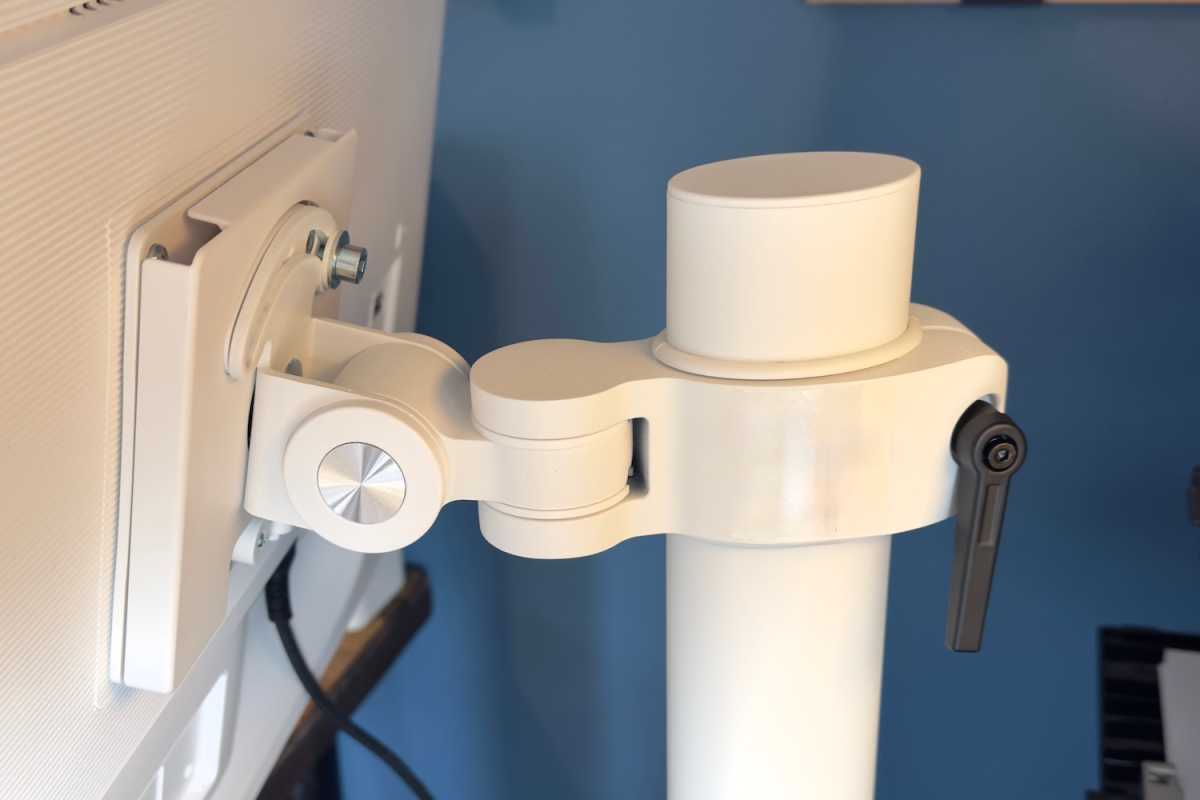
Once everything is out of the box, assembly is straightforward, though it does require tools (which are included). First, the power cord is cabled through the tall pole stand, then the pole attaches to the base with screws and the monitor mount clamps onto the neck. The mount’s vertical position offers a good degree of adjustment.
Matthew Smith / Foundry
Finally, the monitor attaches to the mount with a VESA bracket, which screws to the back of the monitor. The bracket slides onto the mount and a final screw secures them tightly together.
Setup definitely takes some doing. It took me about half an hour from start to finish. However, aside from the tightly packed box, I don’t have any complaints. The assembly instructions were useful and the various pieces screwed or clamped together without issue.
Samsung Movingstyle M7 design
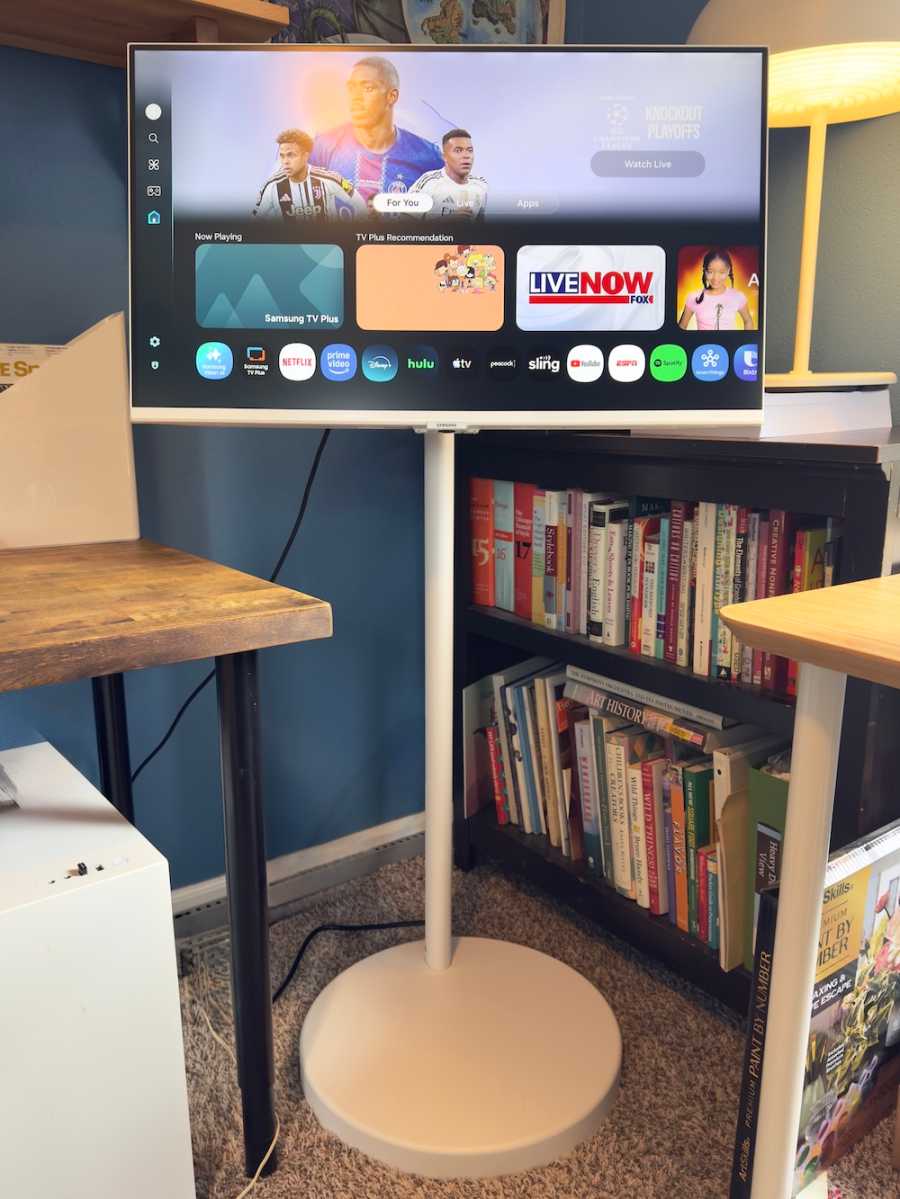
Once assembled, the Samsung Movingstyle M7 has a clean, if obviously unusual, aesthetic. It is basically a 32-inch monitor mounted to a pole, so it is not exactly subtle, though the white colorway and curved design help it blend into a typical home environment.
Matthew Smith / Foundry
Samsung pitches this monitor squarely at home users, though it would also work well in a conference room. It is envisioned as a mobile display that can move between a kitchen, a home office, or a guest room as needed. The wheeled stand provides that mobility, allowing the monitor to be positioned where it is needed and rolled aside when it is not. The wheels are small and the clearance on the base is slim, however, so the stand will only roll on flat surfaces like hardwood or tile.
One of my biggest concerns before I assembled the Movingstyle M7 was its stability. Fortunately, the stand holds up well in normal use. The base weighs almost 40 pounds, which is roughly four times the weight of the monitor itself, so an accidental bump or jostle is not going to send it to the floor. A determined shove can still tip it, though, so I would be cautious about using this monitor in a home with young children or a rambunctious dog.
You will also want to think about the power cord. The Movingstyle M7 doesn’t include a battery and so requires a connection to a power outlet. Samsung’s marketing materials show the monitor with a lengthy white cord, but my review unit shipped with a black cord roughly 10 feet long.
Though the wheels on the base make the monitor mobile, you won’t always need to move it for use, as the mount also adjusts for swivel, tilt, and height—though the height adjustment requires unclamping the mount from the pole, which is a bit finicky. The mount also supports 90 degrees of rotation into portrait orientation for those who want to use it that way.
Curious readers might wonder if the Movingstyle stand can be used with other monitors. This is physically possible, as it uses a standard 100x100mm VESA mount, but the monitor’s documentation warns against it. I suspect that’s because the weight of the monitor attached has an impact on stability and Samsung doesn’t want to be liable for a too-heavy monitor tipping over. In any case, Samsung doesn’t sell the stand alone. It’s a complete package.
Though the wheels on the base make the monitor mobile, you won’t always need to move it for use, as the mount also adjusts for swivel, tilt, and height…
Samsung Movingstyle M7 connectivity
Connectivity is not the Samsung Movingstyle M7’s most important feature, and it shows. The monitor offers two HDMI 2.0 video inputs and a USB-C port that supports DisplayPort alternate mode. The absence of a standard DisplayPort input may frustrate users who want to connect a desktop PC, though that is probably a less common use case for a monitor like this.
The USB-C port also functions as an upstream data connection, linking to three downstream USB-A 2.0 ports.
The monitor also has Wi-Fi 5 and Bluetooth 5.2. The Wi-Fi connection allows the monitor to stream content directly from the internet without a connected PC, and the Bluetooth connection supports peripherals including game controllers. The monitor also supports AirPlay for wireless video from Apple devices.
Samsung Movingstyle M7 menus and features
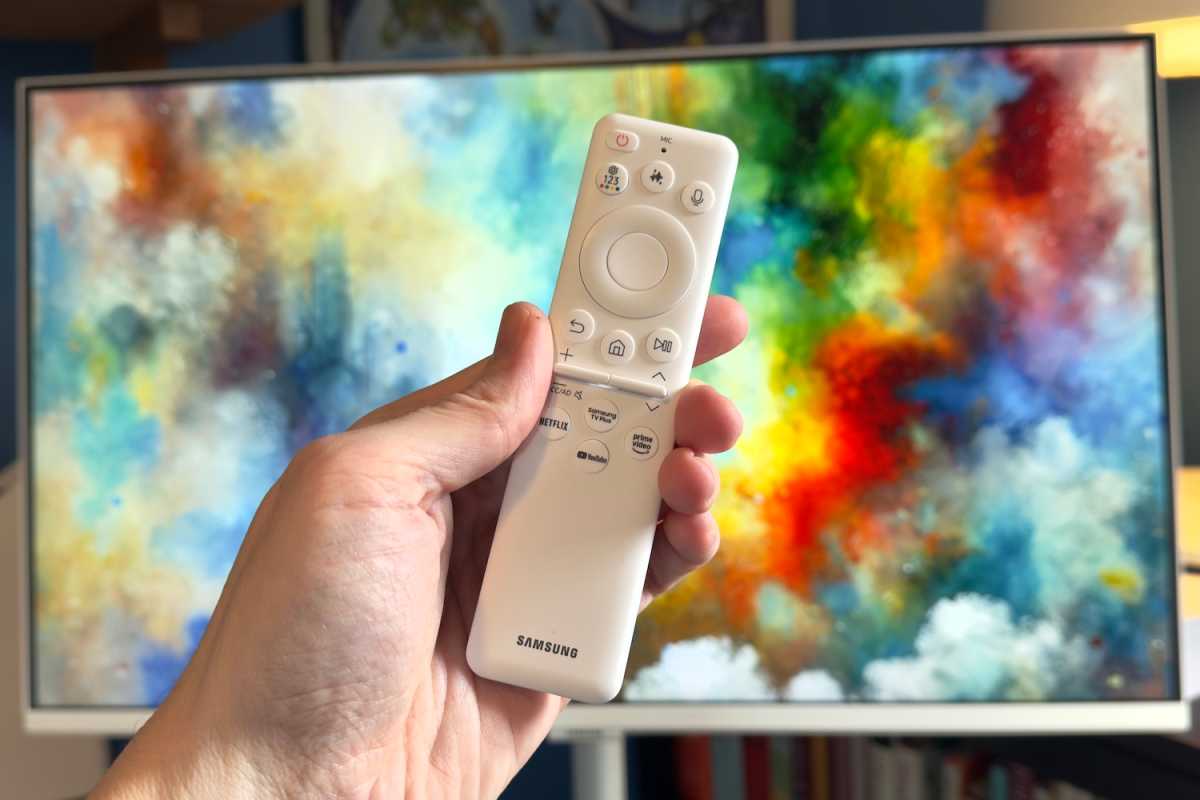
The Samsung Movingstyle M7 is a full-fledged smart monitor running Samsung’s Tizen OS, the same operating system used by Samsung’s smart televisions. The monitor also ships with a wireless remote control. For all practical purposes, this makes it a 32-inch smart TV. It can stream content from all the major streaming apps, access Samsung’s own services, and run cloud gaming platforms without any external device connected.
Matthew Smith / Foundry
These features are always at least somewhat useful, but they are particularly useful here. The Movingstyle M7 can function as a fully independent display that needs nothing more than a power outlet and a Wi-Fi connection. I expect a lot of owners will purchase this monitor with no intention of ever connecting an external video source.
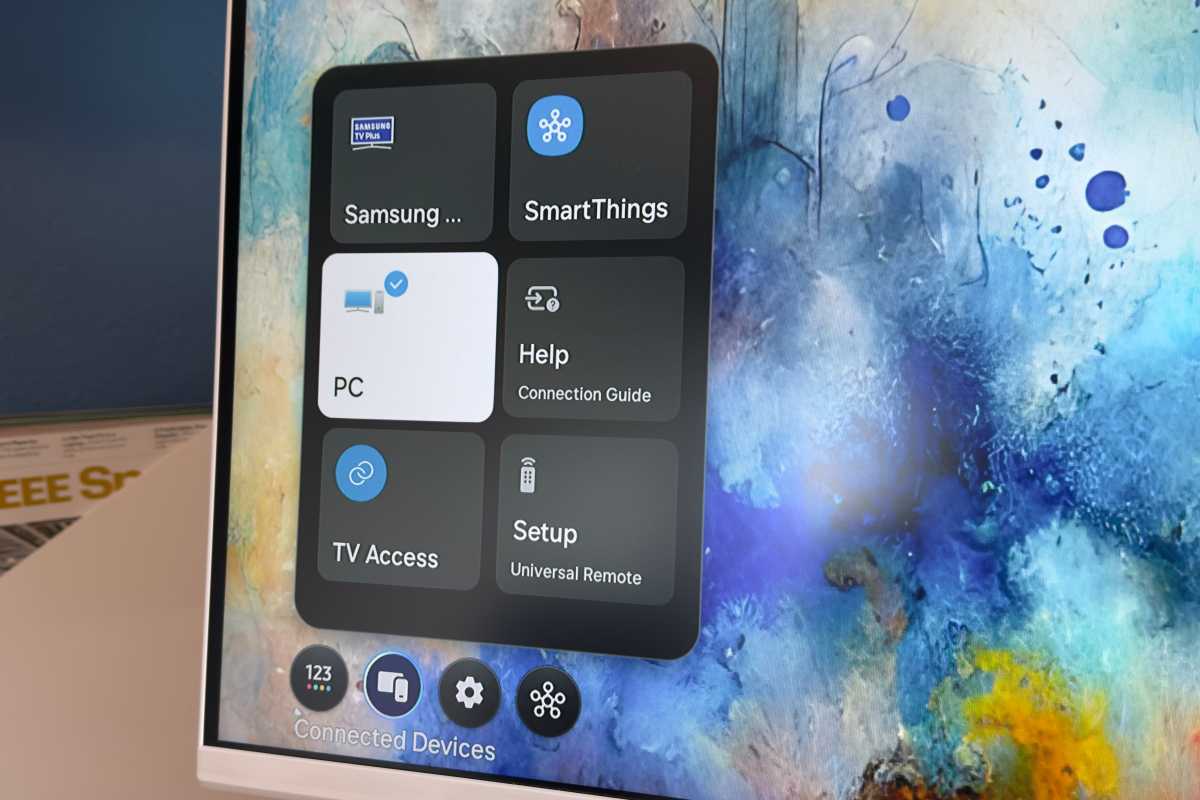
The Tizen experience is serviceable. As with other Samsung smart monitors I have reviewed, the operating system can feel sluggish when opening settings menus and navigating between options. The interface leans heavily on icons paired with labels that are sometimes truncated and lose meaning out of context.
Tizen is of course optimized for a television experience, so your opinion of it will depend on how much you intend to use the Movingstyle M7 as a TV versus a monitor. It’s frustrating if you only want to use the display as a monitor, as everything from setup (which requires Wi-Fi) to changing brightness takes longer than it should.
The included remote is essential. However, there’s a multidirectional joystick and a few buttons tucked around the rear center of the display that can serve as a backup if the remote goes missing or you need to make a quick adjustment. In practice, though, you will want the remote in hand for nearly everything.
Matthew Smith / Foundry
Samsung Movingstyle M7 audio
The Movingstyle M7 includes a 10-watt speaker system that delivers serviceable audio quality. Maximum volume is okay for a home office or guest bedroom, but it falls short in larger spaces like a living room or kitchen, especially if you are actually cooking and competing with background noise. Audio quality is clear but flat so more dynamic content like music and movies sound hollow.
This is normally the part of a monitor review where I recommend external speakers and mention that most monitors don’t have great speakers, if they have any at all. The catch here is that using external speakers with the Movingstyle M7 is more complicated than usual. Any speakers you pair with this display should ideally move with it, but the stand doesn’t have a mount for them, so you’ll need to give your audio setup some thought.
Samsung Movingstyle M7 SDR image quality
Samsung’s Movingstyle M7 in fact pairs the stand with the Samsung Smart Monitor M7, which can be purchased on its own (the stand, however, is only available as part of the Movingstyle M7). The Smart Monitor M7 is an affordable monitor with an MSRP of $400, which is often slashed to $250 or less. So, how does its image quality stack up?
Matthew Smith / Foundry
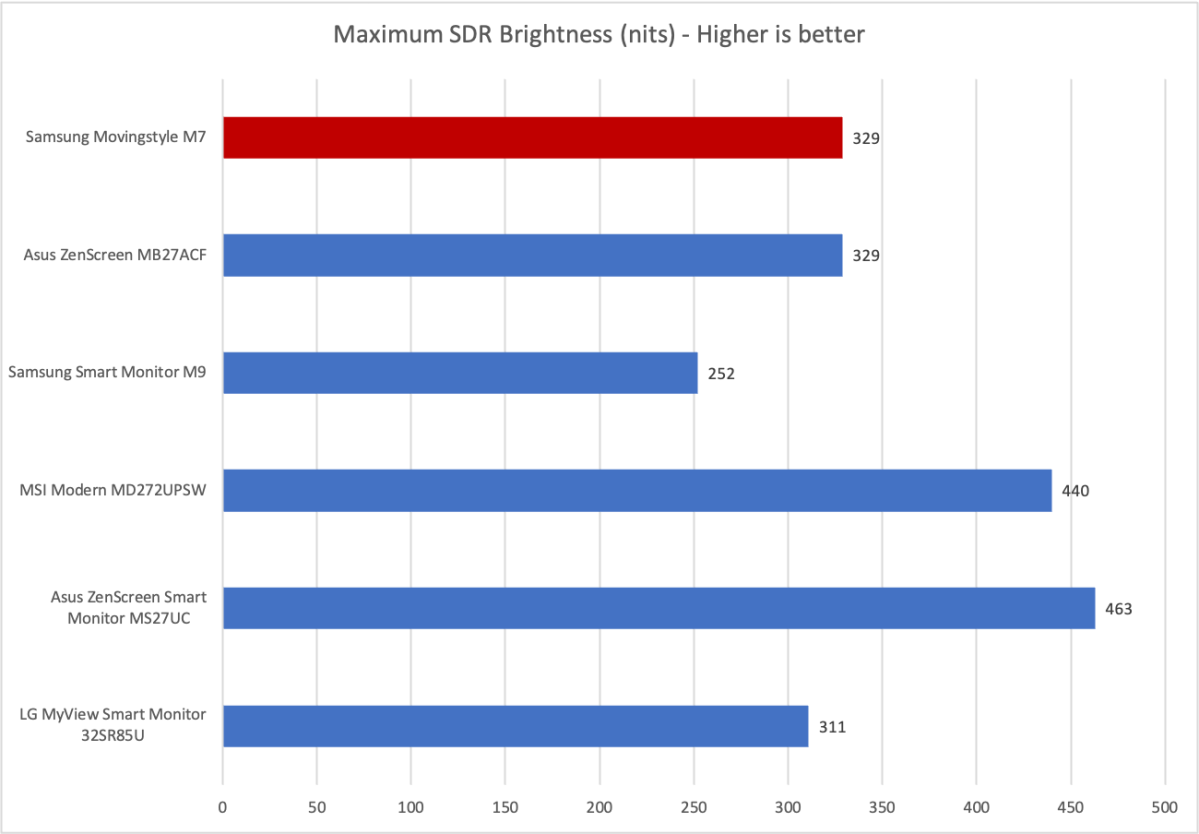
I measured a maximum SDR brightness of 329 nits which, as the graph shows, is a fine but middle-of-the-road value.
This level of brightness is much more than what’s required in most rooms. However, the Movingstyle M7’s mobility means it’s more likely to be used in a living room or kitchen with a lot of ambient light and no way to reduce it. In those situations, the monitor’s SDR brightness can prove merely adequate.
Matthew Smith / Foundry
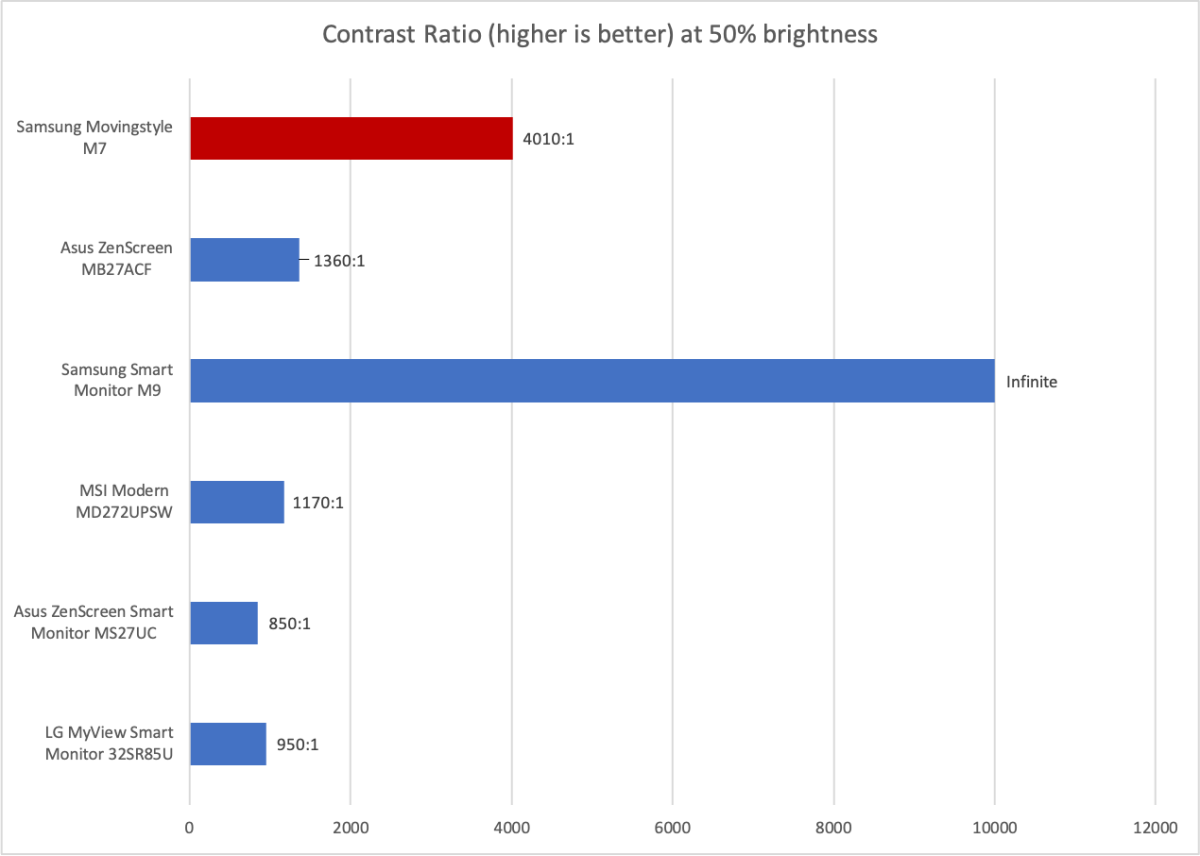
Contrast is a win for the Movingstyle M7, as the Samsung Smart Monitor M7 has a Vertical Alignment (VA)-LCD panel. This type of panel can deliver lower levels of brightness in dark scenes, which improves overall contrast and provides a more immersive image.
Of course, the Movingstyle M7 won’t match an OLED display, which will look far more alluring and pack more detail into dark scenes. Still, the Movingstyle M7 performs well enough to provide enjoyable contrast in a wide range of movies and games.
Matthew Smith / Foundry
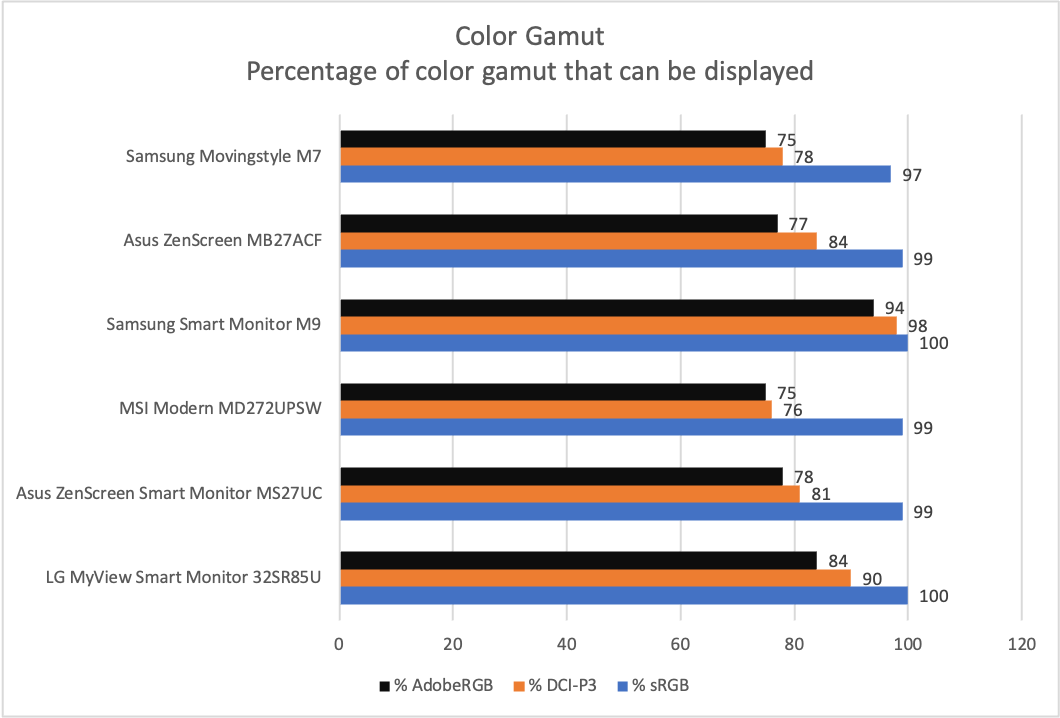
Unfortunately, the Movingstyle M7’s color gamut is a weakness. I measured a gamut that spanned only 97 percent of sRGB and 78 percent of DCI-P3. As the graph shows, this is a fairly narrow color gamut for a modern display and it’s where the Smart Monitor M7’s low price is most apparent.
The narrow color gamut is obvious in real-world use. Content looks unsaturated and lacks the impact it would have on a display with a wider color gamut. It’s passable, but it’s not going to impress viewers who are even moderately critical about image quality.
Matthew Smith / Foundry
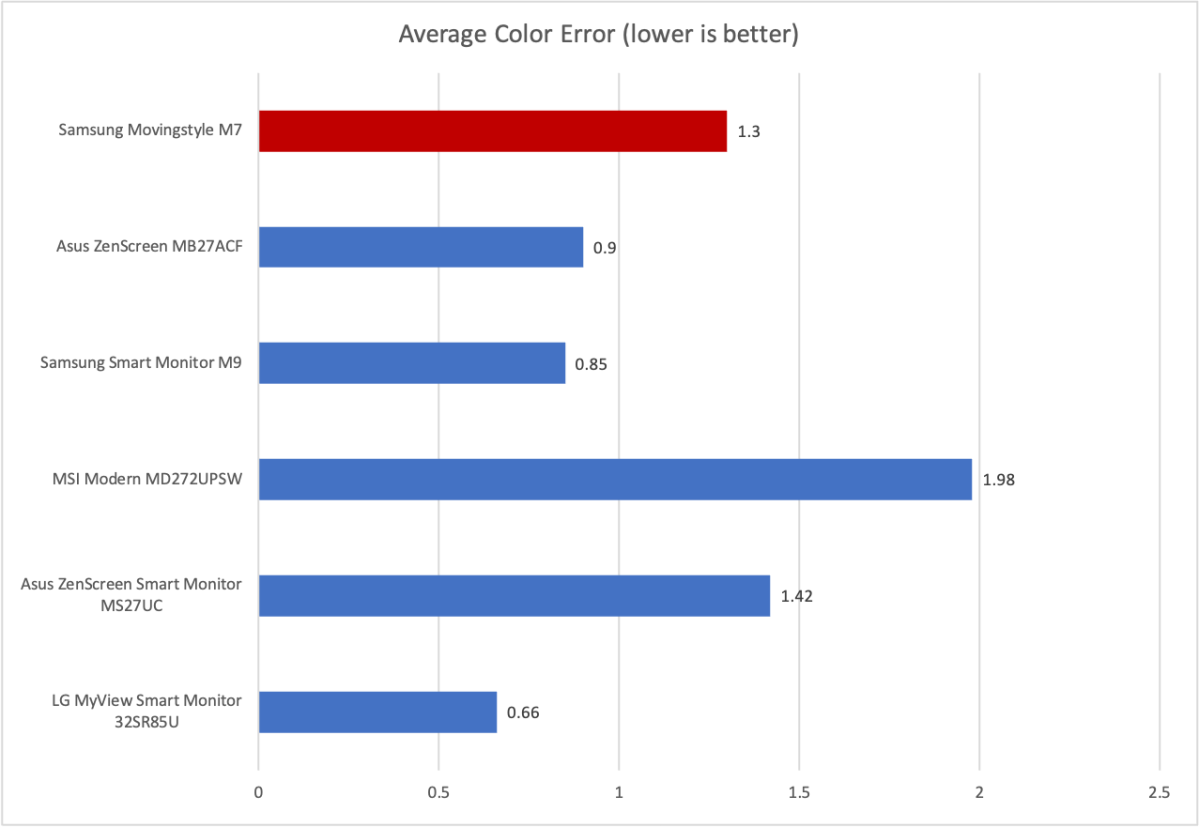
Color accuracy is better, though the story has nuance. My testing found a very low color error across most colors, but a high color error (delta 6.3) in cyan. Subjectively, I thought the monitor lacked the ability to show much nuance in the blue-cyan range, causing colors in this range to seem particularly muted and unremarkable.
The Movingstyle M7 results were once again solid in gamma and color temperature. I measured a gamma curve of 2.2, which is what I expect to see at default settings. I also measured a color temperature of 6700K, which is only a tad off the target of 6500K. That means the image looks a bit cooler than what’s ideal but is generally well-balanced.
Sharpness is good, too, as the monitor delivers 3840×2160 resolution. If anything, the monitor tends to look a bit sharper than most 4K monitors in normal use. That’s because I typically viewed the monitor from further away than a desktop monitor. I was often at least 4 feet away from the Movingstyle M7 when viewing it. At that distance, a 32-inch display with 4K resolution looks remarkably crisp.
The Movingstyle M7’s overall SDR image quality is not remarkable but holds up well enough. It provides solid contrast and a well-balanced image with generally good color accuracy. However, the monitor’s color gamut and brightness could be better. The vast majority of monitors in the same price range will have better image quality but, of course, they also won’t have a mobile stand.
Samsung Movingstyle M7 HDR image quality
The Samsung Movingstyle M7 technically supports HDR, as it can accept an HDR10 signal. However, aside from the mention of HDR10 support in the monitor specifications, Samsung doesn’t mention HDR.
That’s for good reason. While an HDR10 signal can be viewed, it doesn’t look great due to the monitor’s limited brightness and color gamut. I wouldn’t say that HDR content looks better than SDR at all—just a bit different in terms of overall color presentation.
In short, the Movingstyle M7 isn’t a good choice if HDR is at the top of your list of priorities.
Samsung Movingstyle M7 motion performance
I can say the same for the Movingstyle M7’s motion performance. The display has a maximum refresh rate of 60Hz and doesn’t offer adaptive sync, so motion fluidity isn’t great in modern PC or console games. I also noticed a lot of motion blur, which reduced motion clarity. To be clear, the motion performance looked fine for movies and shows. But if you’re interested in attaching a PlayStation, Xbox, or gaming PC, you’ll likely be disappointed.
Is the Samsung Movingstyle M7 worth it?
The Samsung Movingstyle M7 is a niche monitor that does what it was designed to do. It’s easy to assemble, moves across flat surfaces without trouble, and has a stand that makes the monitor usable almost anywhere you have open floor space.
At a glance the $700 MSRP might seem steep, but it’s not bad for this type of display. LG’s StandByMe and Smart Monitor Swing are both currently priced around $800 at retail. You might save money if you go the DIY route and choose a stand and monitor independently, but the end result is unlikely to look as attractive (and in some cases will be downright ugly).
If you want a large mobile display that you can position nearly anywhere the floor space is available, the Samsung Movingstyle M7 is a sensible choice.
