
Workstation GPUs: PC gaming’s new enemy
All three PC GPU makers now appear to be leaning harder into AI-specific graphics cards, straining a tight PC graphics market even further.
A few years ago, PC gaming was seen as a huge growth driver for the silicon industry, enthusiasts, and PC makers alike. Now, the meteoric rise of AI is luring hardware makers away from consumers, and we’re seeing even more consequences as a result.
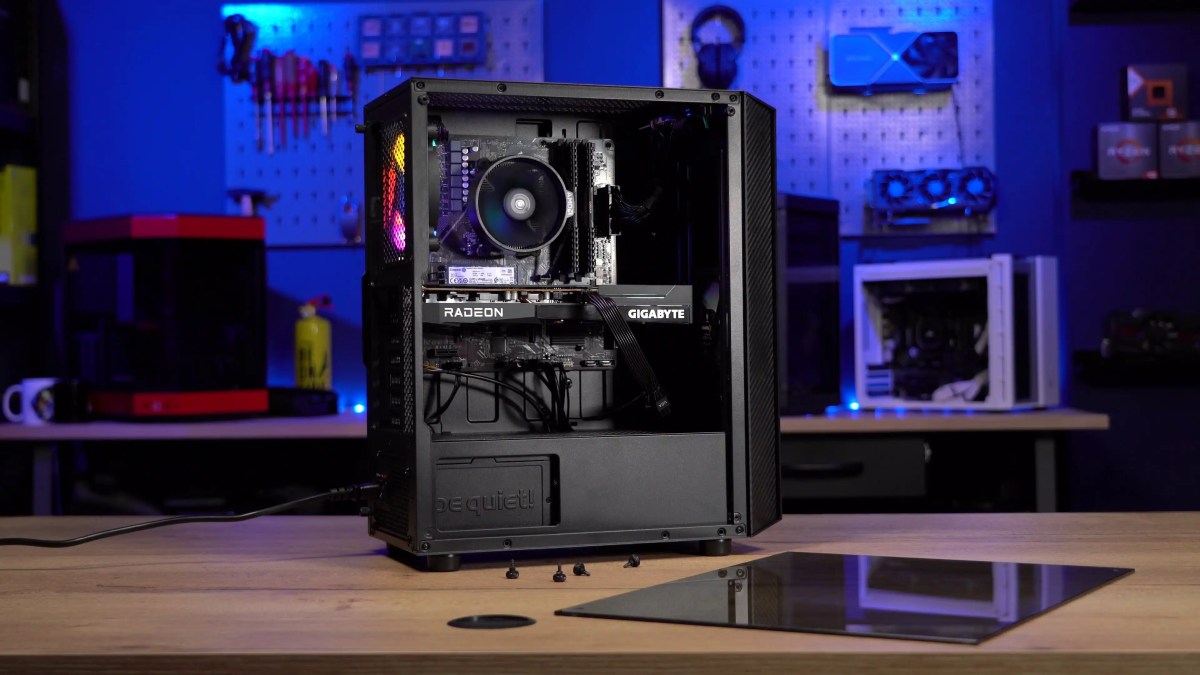
This week, AMD launched the Radeon AI Pro R9700 graphics card for AI workstations, alongside the Radeon AI Pro R9700S and Pro R9600D for rack computing. Intel is reportedly launching the Arc Pro B70 and Arc Pro B65 this month, most likely specifically for running LLMs. And Nvidia is projected to possibly skip 2026 entirely for a release of consumer GPUs, concentrating on selling entire systems like Vera Rubin rather than a consumer Rubin-based PC graphics card.
All of that GPU silicon could have landed on consumer PCs — and probably would have, several years ago. Now, we saw GPU shipments fall late last year because of AI hyperscalers. Now workstations have joined the crowd, beating up on the PC.
IDG
The relatively small number of workstations sold likely means that shifting the graphics silicon to workstations and datacenters might not have an enormous impact on PC GPU sales. But the traumatized PC market is weathering shortages of RAM and SSDs, alongside possible shortage of Intel CPUs and a graphics market that has undergone shortages before. Like the proverbial straw that broke the camel’s back, it just strains the system further — and if not in shortages of GPU silicon, than the accompanying video RAM.
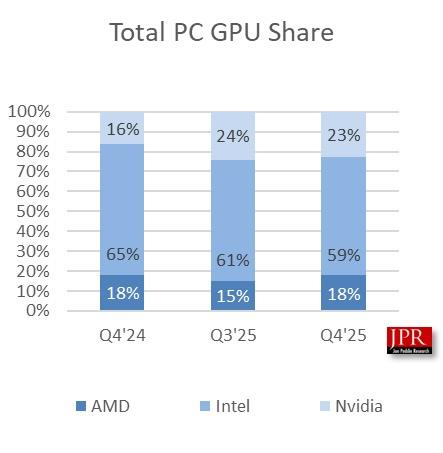
In a report issued Tuesday. GPU analyst Jon Peddie Research found that PC GPU shipments dropped 1.3 percent from last quarter, unusual when the fourth quarter is typically the high point of the year. GPUs sold into data centers, however, climbed 17 percent.
JPR also found that the GPU attach rate for PCs fell to 116 percent, down 3.9 percent sequentially. (The attach rate refers to the number of GPUs sold per PC. In this case, a PC could have two GPUs — an integrated chip as well as a discrete graphics card, increasing the overall percentage.)
Sadly, pivoting away from the PC makes sense
Anyone who isn’t Nvidia has some tough choices to make.
Intel made a strong showing in its Core Ultra Series 3 (Panther Lake) notebook GPUs, but the market has continually wondered when Intel would bring its “Big Battlemage” architecture to market as a desktop graphics card. While it surfaced last year, the latest report from Videocardz now positions the Intel B70 in the context of an LLM packaged stack for running and benchmarking LLM performance on its multi-GPU Arc platform. (The reference has since been removed from the Intel page.)
The implication is that Intel may be stealing a page from AMD’s Radeon AI Pro R9700 card and directing its B70 architecture into the AI market, rather than pushing pixels on the PC.
Pivoting between a desktop gaming GPU and one specifically designed for the workstation isn’t that difficult, relatively. They can both use the same basic silicon platform, but differ in both the attached memory as well as the driver software. Workstations use what are known as certified drivers written specifically by an Autodesk or a Siemens for a specific card, while Windows will use Microsoft’s DirectX API, explained JPA principal Jon Peddie in an interview.
“What I think is going on is that these guys are trying to tiptoe into the market, but maybe don’t have quite the [AI] capability that Nvidia has on their machines and that AMD has in their Instinct [data center] stuff,” Peddie said. “And so they’re saying this is kind of like a little brother AI GPU. That’s the way I see it playing out.”
@realVictor_M (X.com)
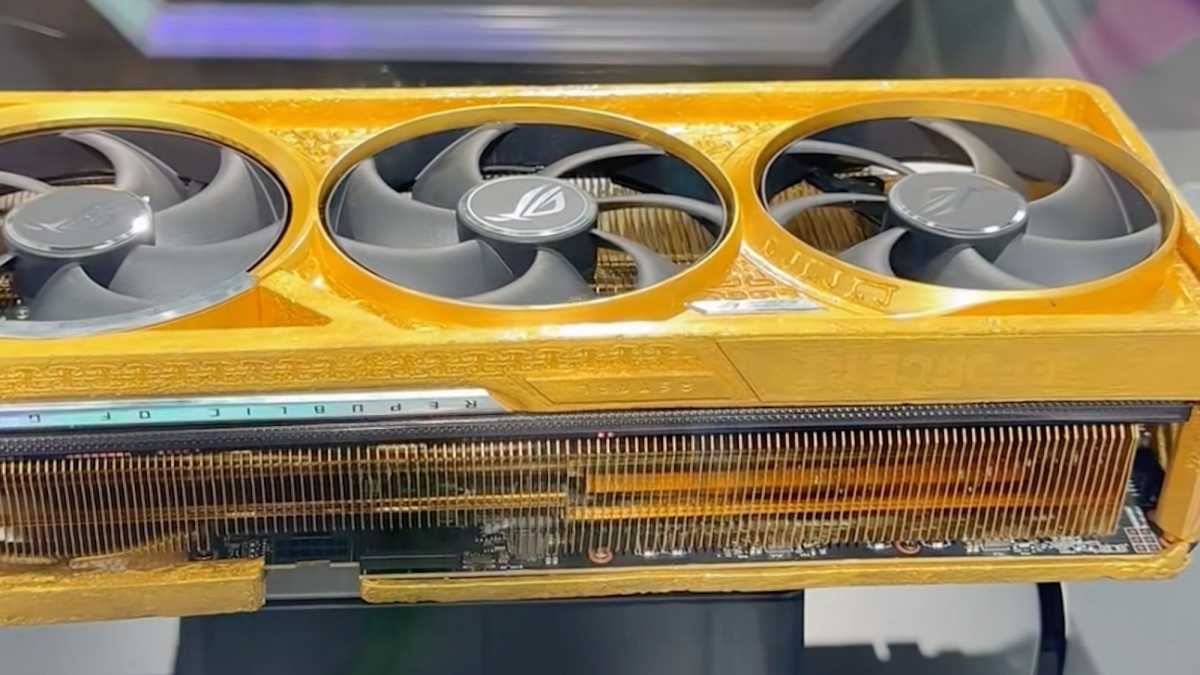
And why wouldn’t they? Workstation-class cards typically sell for about three times of a desktop graphics card; current prices of an Nvidia RTX 5090 run (gulp) $3,699 on Newegg, but new RTX Pro 6000 cards with 96GB of GDDR7 memory are selling for about $9,000 on eBay. If AMD or Intel were able to swap out PC graphics cards for those kinds of prices in workstations, you could argue that they’d be foolish not to. (A workstation card can be used by a typical desktop PC, but typically isn’t — its drivers aren’t optimized for gaming.)
It’s not really about the numbers. The number of workstations sold annually is tiny — 7 million or so — versus the 280 million PCs that were sold in 2025. Datacenter GPUs prefer high-bandwidth memory, or HBM, but it’s the memory that is the concern. Graphics cards for both the PC and workstation typically use some flavor of GDDR memory. (Workstations may also add error-correcting or ECC logic to prevent crashes of critical applications.) But workstations also snap up more of that memory, too: between 32 and 48GB of memory versus the 12 to 24GB of memory that a consumer card uses.
All this means is that any shift away from the PC will likely strain the supply of PC graphics-card memory further. And the conclusion is not one you’ll want to hear.
“The signals we’re getting from the suppliers and the geopolitical things that are going on is that we see that there is just going to be no availability, period,” Peddie said. “The availability is going to be very limited, and so that, in turn, is just going to push people to stop purchasing. So if you were going to go refresh your PC or your graphics board, even in 2026, now you’re going to go, ‘maybe not.’
“The price just went up by 50 percent — I don’t need it that badly, right?” Peddie added. “It’s a nice to have, but it’s not a must have. I’ll just wait this out until the prices come back down — which is going to devastate PC and graphics board sales for the consumer.”
