
Nvidia’s dynamic frame gen will max out your monitor on March 31
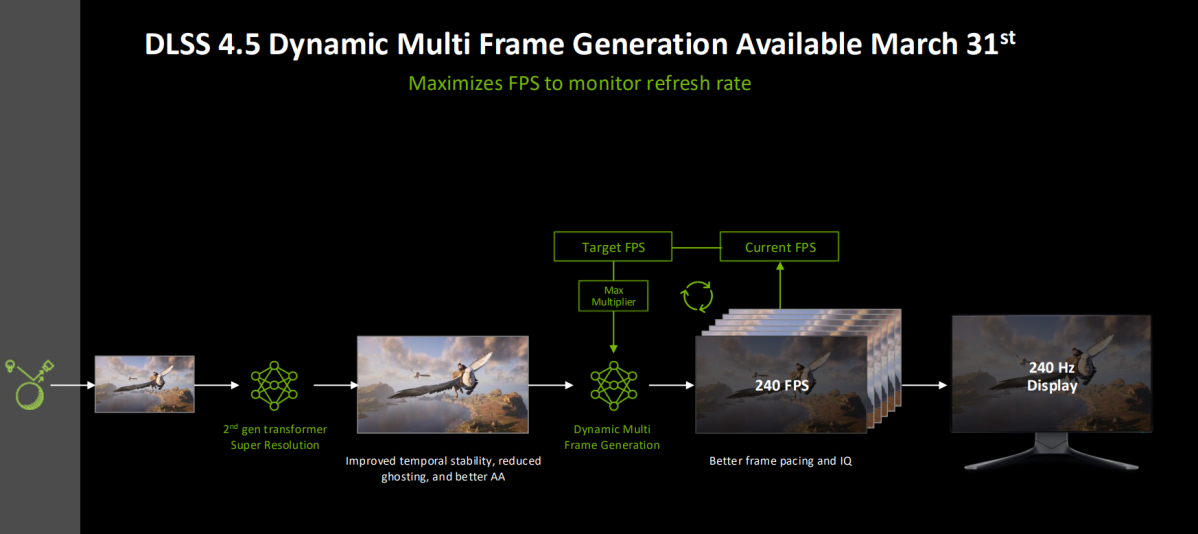
Nvidia is powering up its DLSS technology, as previewed at CES at the beginning of the year. According to an announcement at the Game Developers Conference in San Franciso, DLSS 4.5 will bring a collection of new improvements starting March 31st. This includes Dynamic Multi-Frame Generation, which allows DLSS to dynamically adjust its output to hit performance targets, usually based on your monitor’s refresh rate.
DLSS 4.5 Dynamic Multi Frame Generation (say that five times fast) will let DLSS automatically adjust the factor of the frame generation, from 1x to 6x at maximum on hardware that can handle it (so, five generated game frames for every one rendered). In supported games, this is done in an attempt to keep pace with your framerate target (typically the max of your monitor, such as 240Hz) while keeping rendered frames at maximum for any given portion of the game.
Nvidia
There’s a bunch of other goodies announced as part of the GDC blowout, too. RTX Mega Geometry to boost frame rates in path-traced games, plus a special variant for foliage, path tracing support for 007 First Light and Control Resonant, and several community projects that bring RTX lighting to older games like Portal 2, Need for Speed: Carbon, and Call of Duty 2. Nvidia is also offering GeForce Now as a method for developers to offer playtests during development, an interesting approach.
But there’s also a conspicuous absence from GDC, just like CES: new hardware. The GeForce RTX 50-series Super variants that had been rumored in 2025 are nowhere to be found, and as far as we know, may never materialize, amid talk of scaled-down production of consumer gaming cards in favor of “AI” industrial output.
