
Intel and Phison want to solve local AI’s biggest limitation
Summary created by Smart Answers AI
Table of Contents
In summary:
- PCWorld examines Phison’s aiDAPTIV technology, which partners with Intel to enable 26-billion-parameter AI models on laptops with just 16GB RAM instead of the typical 32GB requirement.
- The solution uses specialized Pascari AI100E SSDs as AI cache storage for tokens, significantly improving local AI response times and expanding accessibility across more devices.
- However, the expensive Pascari SSDs cost $2,516 for 1TB, raising concerns about widespread adoption given Intel’s past failures with proprietary technologies like Optane memory.
Not everyone wants to run local AI on their own PCs. But if you do, there’s a major problem. Most sophisticated models can’t fit inside the limitations of your PC’s memory and storage. Phison and Intel are working on a solution.
Using Phison’s aiDAPTIV solution, a 26 billion parameter AI model can be run on a laptop with 16GB of RAM, versus the 32GB of RAM it would normally require. That has two advantages: bringing local AI to more laptops and allowing more powerful laptops to load even larger models or else run separate tasks alongside AI. On a PC, AI can monopolize system resources, preventing any other work from being done. This can sometimes force a user to buy a dedicated AI PC.
It’s a simple productivity solution, allowing either larger AI models to be run on a PC or freeing up a laptop for other tasks.
Running out of room
Part of AI’s hardware problem is that it has to calculate tokens, whether for something as simple as asking an LLM for a poem or a more complex set of instructions to monitor oil prices and make predictions. In either case, tokens are being generated on the fly inside the video memory. (Intel traditionally split half of a laptop’s system RAM between the integrated GPU and Windows, before allowing consumers to manually adjust the allocation in August 2025.)
The problem is that as a user goes on and on with an LLM, it has to remember what the original prompt instructions were as well as updates. Those can be recalculated again or stored as a reference. The problem is that AI functions are typically processed in video RAM or system RAM that’s shared with the GPU. The result? Everything bogs down.
Since RAM is where AI functions are computed, robbing a portion of it to “store” data lessens its effectiveness.
But there’s a solution and it’s one you’re probably already familiar with. Microsoft Word runs on your PC’s CPU and uses RAM to do it, but documents are stored in the cloud or in the SSD. If Word needs a document, it asks Windows to retrieve it from your SSD. Phison does something similar.
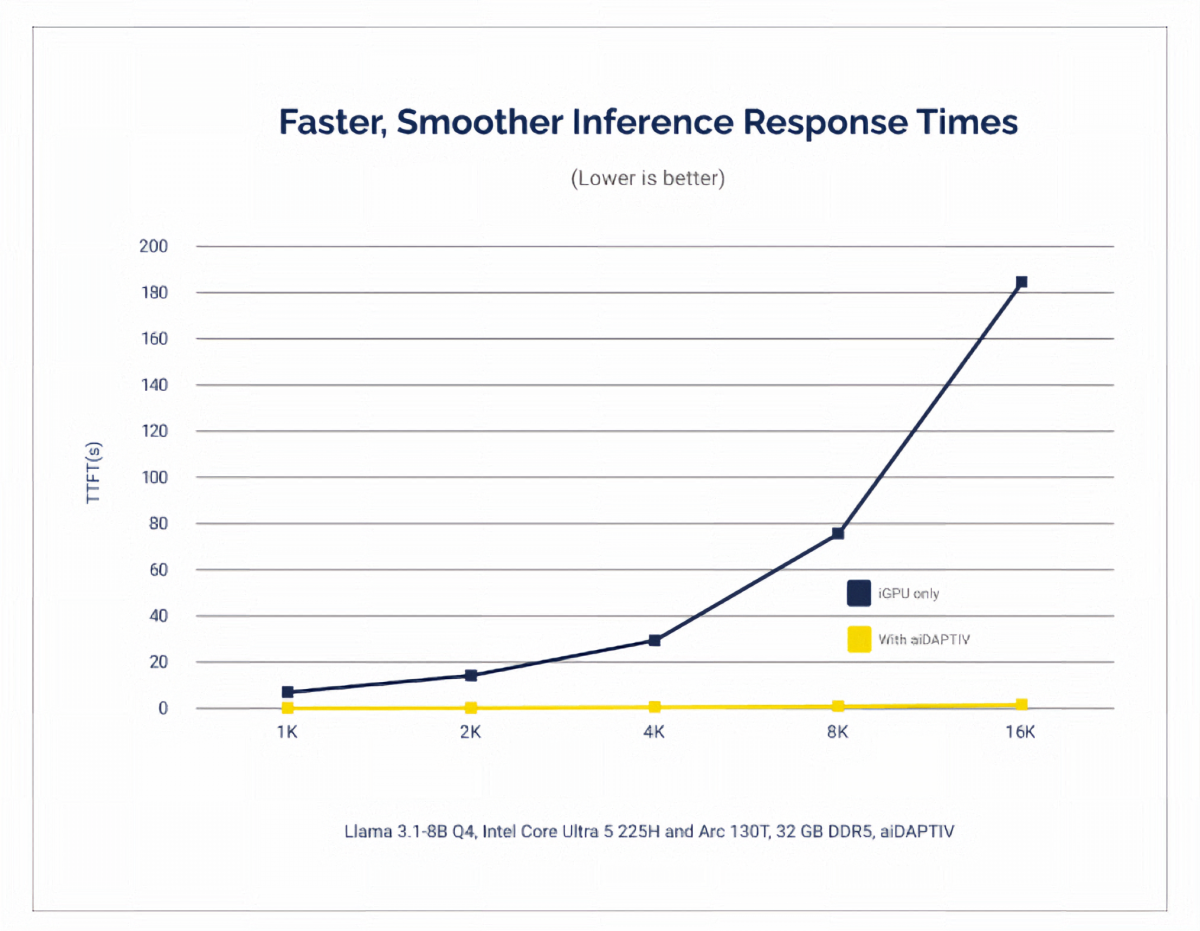
What Phison’s aiDAPTIV does is use high-performance, extreme-endurance NAND flash as an AI cache, storing tokens to be recalled for later use. (Technically, the cache stores the key-value (KV) data, which grows with the context length and model size.) Normally, this would slow down the entire process. What aiDAPTIV tries to do is anticipate the model’s needs, intelligently sending data back and forth between the RAM and the SSD to allow you to run larger models without impacting performance.
Phison
The collaboration focuses on enabling Phison’s technology on Intel AI PC platforms powered by Intel Core Ultra processors, including support for the OpenVINO toolkit, the two companies said. Together, Phison and Intel are working to demonstrate the technology for software vendors, which could eventually optimize their own apps for the technology.
Of course, assuming users want to run AI locally instead of in the cloud with ChatGPT or Claude. It also assumes that users will want to run “full fat” versions of their AI models, rather than quantized models that trade accuracy for lower memory requirements and higher speed.
We’ve gone down this road before…
The aiDAPTIV concept sounds simple enough, but there’s a potential catch. The joint work is being performed using Phison’s Pascari AI100E family of specialized SSDs, which are designed for high endurance and sustained performance. That suggests that a successful implementation may require a laptop maker to specifically buy the Pascari SSDs. At press time, a 1TB Pascari AI100E in an M.2 2280 configuration costs $2,516 at Best Buy.
Intel has gone down that road before. Optane, based on 3D XPoint memory, was an entirely new type of memory co-developed between Intel and Micron, and it behaved more like traditional memory than flash. But a lack of consumer demand forced Intel to shut down its Optane SSDs in 2021 before writing off half a billion dollars in inventory a year later.
A quarter century ago, I also covered the launch, delays and eventual demise of Direct Rambus DRAM, in which memory manufacturers were asked to sign on to a partnership between Intel and Rambus over a specific type of PC memory. While memory vendors publicly agreed, privately they trashed Rambus and its licensing requirements. The lesson? A technical advantage is one thing, but being forced into a single supplier or technology is another thing altogether. We’ll see how this all plays out.
