
You can pay $15,000 to touch this MacBook Pro’s screen. Hurray?
That’s the Apple premium in 2026, where Macs now cost about what I paid for a used car a year or so ago.
You know where this money is going, of course. Apple’s latest 14-inch MacBook Pro starts at $2,899, and the optional 16-inch model—where the premium goodies really begin—starts at $3,399. Load up your MacBook Pro with 128GB of memory, and you’ve just committed to a $7,399 laptop, at or above the highest echelons of the Surface Laptop Ultra and competing RTX Spark machines. As it is, I reviewed a “low end” 15-inch Microsoft Surface Laptop Ultra (base price $2,599) and the $3,699 review price would be at the high end or higher than laptops from a few years prior.
It’s when you add storage that MacBook Pro PROLED prices really soar: 2TB of storage is included on the base 16-inch laptop, but a 16TB SSD is a $7,000 addition. Just for the ability to download and store additional AI models (because let’s face it, everything is AI these days). And it doesn’t even run an M6 chip, just an M5 Max or Ultra.
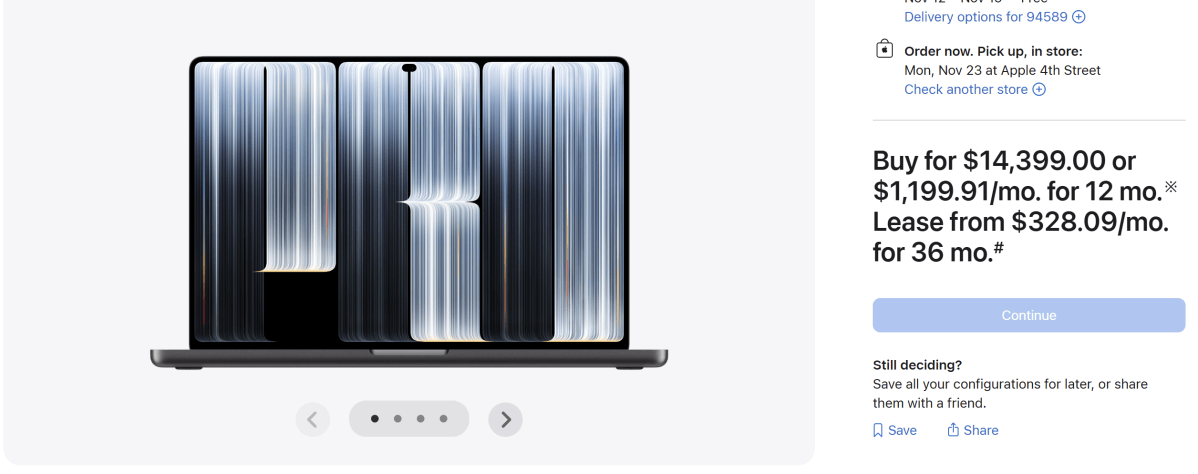
In true Apple fashion, Apple doesn’t even give a reason for including a touchscreen. Like royalty, Apple is never early nor late; it is always on time. There’s nothing particularly amazing about this touchscreen, though you can touch and swipe and rotate and so on. TikTok may be full of influencers explaining how this new way of interacting with their laptop is at once cool, revolutionary, and a dynamic improvement over the status quo. It’s just as likely, however, that the touch display will end up as interesting as the illuminated Apple logo on the back of the device.
Who’s the new MacBook Pro for? Not me
In 2020, PC users might have had actual debates about what the incremental value of a laptop meant, and what premium users could expect to pay for features such as a 1200p screen, a faster processor, 32GB of memory versus 16GB, and so on. Since the average consumer could afford such upgrades—even if it meant stretching their budgets a bit—those discussions were worth having.
But more and more, the price tag of computing is climbing out of reach of a broader segment of the population. In 2025, according to the government, the median household income was $87,460. Divided by 12, that’s $7,288 per month, which sounds like a lot. But add rent, healthcare, food, gas, car payments, and it all adds up.
