Summary created by Smart Answers AI
In summary:
- PCWorld reports on OpenAI’s ChatGPT Health, which allows U.S. users to share medical records and Apple Health data with granular privacy controls.
- The AI service helps users understand medical terminology and provides context for health data, though it mirrors rather than replaces doctor’s advice.
- While useful for medical explanations, the author found ChatGPT Health interesting but not essential, with lingering privacy concerns about chat history retention.
For obvious reasons, allowing ChatGPT to give medical advice is fraught with controversy. Is it really a good idea to trust a large language model with our health? What if it hallucinates, or misdiagnoses clear warning signs (as a just-filed lawsuit alleges)? And can we trust AI chatbots with our private medical data?
Those are all good causes for concern, but they’re not stopping OpenAI from rolling out ChatGPT’s new health-oriented features to all U.S. users. First introduced earlier this year, ChatGPT Health can — with your permission — tap into a variety of medical data sources, ranging from telemetry from the Apple Health app to records from your doctor, and (as OpenAI carefully words it) help you “understand your information in context.”
Now, it just so happens that hours before OpenAI announced its broader ChatGPT Health rollout, I had my annual physical. It was a routine visit (no major problems, phew!), and I’m lucky to have a general practitioner who’s friendly, down to earth, and clear about his findings. Among his directives: watch my diet, exercise more, and cut back on the cocktails. (Oh, c’mon, Doc!)
Normally, I wouldn’t feel the need to feed my checkup details to an AI chatbot; generally speaking, I only like knowing what I need to know about my various health conditions. But this is PCWorld, and I cover AI for a living, so I took a deep breath and agreed to let ChatGPT check my chart.
Just to be clear, right up front: This isn’t a full review, and I am in no way suggesting you try ChatGPT Health yourself unless you really want to. While the service uses a secure portal for linking medical records to ChatGPT and permissions controls abound, I believe there are still plenty of privacy concerns, and by no means should ChatGPT’s musings be confused with the diagnosis of a doctor (as OpenAI is quick to say). The only reason I’m wading into ChatGPT Health is so you can sneak a peek at my experience.
With that lengthy preamble, I’ll start with the nuts and bolts. Navigating to the “Health” menu item in the ChatGPT sidebar (iOS and web only for now, and again, just for U.S. users), a connection wizard guided me through the options, including connecting Apple Health and my healthcare provider.
For each health source you connect, you must decide precisely which data you’d like to share, and the options are quite granular. With Apple Health, for example, you could choose to share your daily steps but not your stand minutes, or pick your heart rate but exclude heart rate variability.

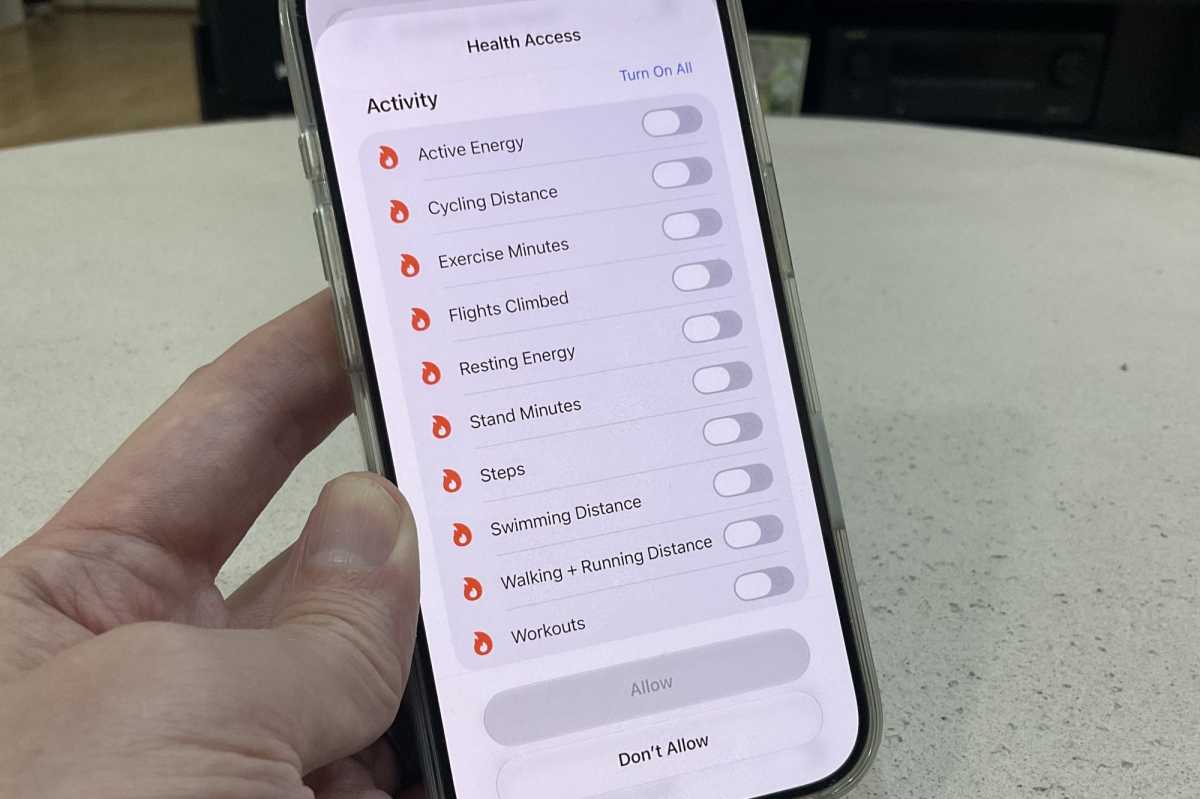
You can choose precisely what medical data gets shared with ChatGPT Health, and what doesn’t.
Ben Patterson/Foundry
The same goes with your health provider; mine, for instance, had individual check-off sections for allergies, care plans and clinical notes, and demographic information, for starters. You can also choose how long you want ChatGPT to have access to your medical data: anywhere from a day to a year.
Next, ChatGPT Health will follow up with more options, including adding medications and family history details, as well as any current medical conditions you’re experiencing.
With the updated ChatGPT Health, you don’t have to visit the Health section in the ChatGPT app to discuss your vitals (although you still can if you want to). Instead, ChatGPT can access your health data from any chat. Ask ChatGPT a health question, and a permissions pop-up will appear, with options for “Allow Once,” “Always Allow,” or “Deny.” If you choose “Allow Once” (as I did), ChatGPT will ping you for permission for subsequent healthcare-related chats.
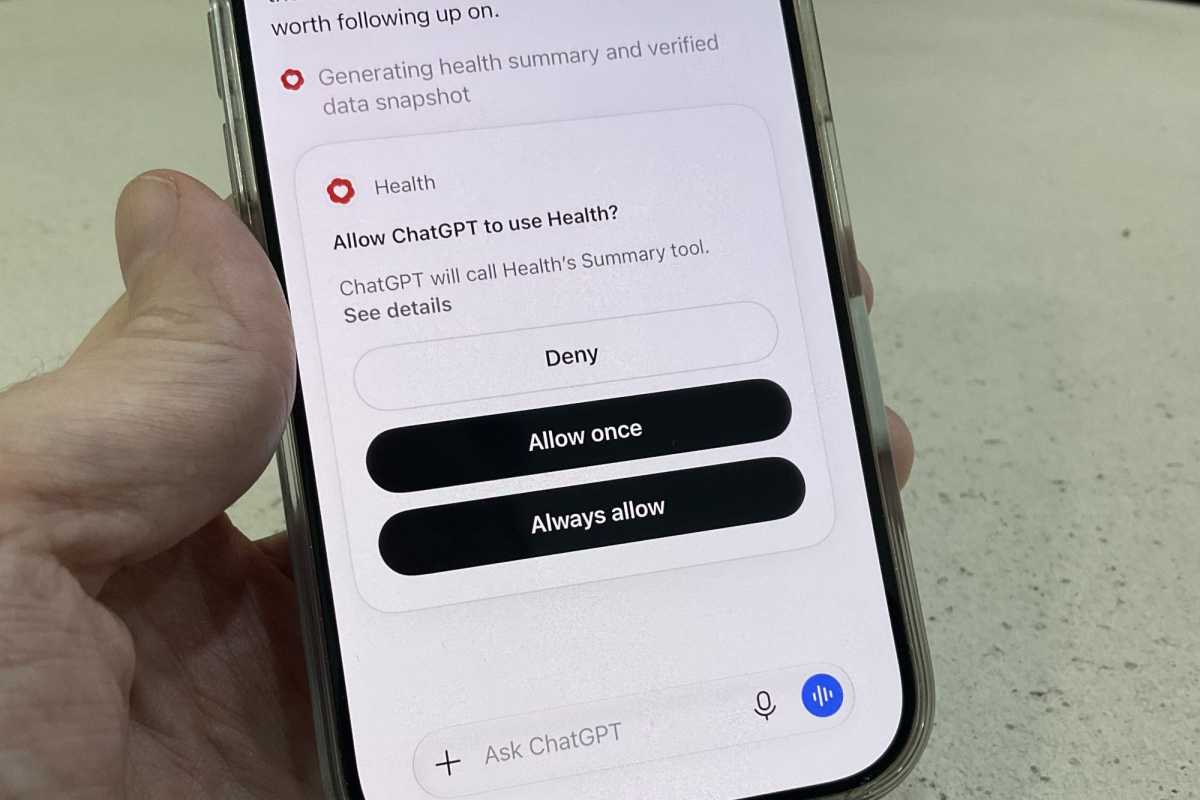
ChatGPT asks you for permission before tapping into your health data.
Ben Patterson/Foundry
In my first conversations with ChatGPT Health, I asked some general questions based on my Apple Health data, including whether it spotted any trends over the past 12 months. We had several back-and-forths about the raw data ChatGPT had access to and the possible types of reports it could compile; indeed, ChatGPT seemed almost timid here, and I had to nudge it (“OK, can you do the annual health review?”) to get its assessment.
When it finally did come, ChatGPT’s summary was interesting if (to me) not all that surprising: “Your year looks stable overall, with several modest improvements toward the end.” It singled out my lower resting heart rate, higher HRV (a signal for overall cardiovascular health), my faster walking speed, and more frequent exercise over the past year.
But I also got dinged for my sleep patterns: not enough, in a nutshell, although my oxygen saturation has been trending up.
Next, I moved on to my recent physical. What did all those test results popping in MyChart mean, anyway (and what’s up with the one in the yellow range)? What’s a lymphocyte count, and why is mine a tad low? And how am I doing overall?
Of course, I already knew the answer to most of these questions, courtesy of my flesh-and-blood doctor (nothing to worry about with this, let’s keep an eye on that). But I do have to say, ChatGPT did a nice job of filling in some of the details and reminding me of others, like the fact that I need a pneumonia vaccine, or that my LDL levels (for “bad” cholesterol) are slightly elevated. “Eat with heart health in mind,” ChatGPT said, mirroring my doctor’s advice.
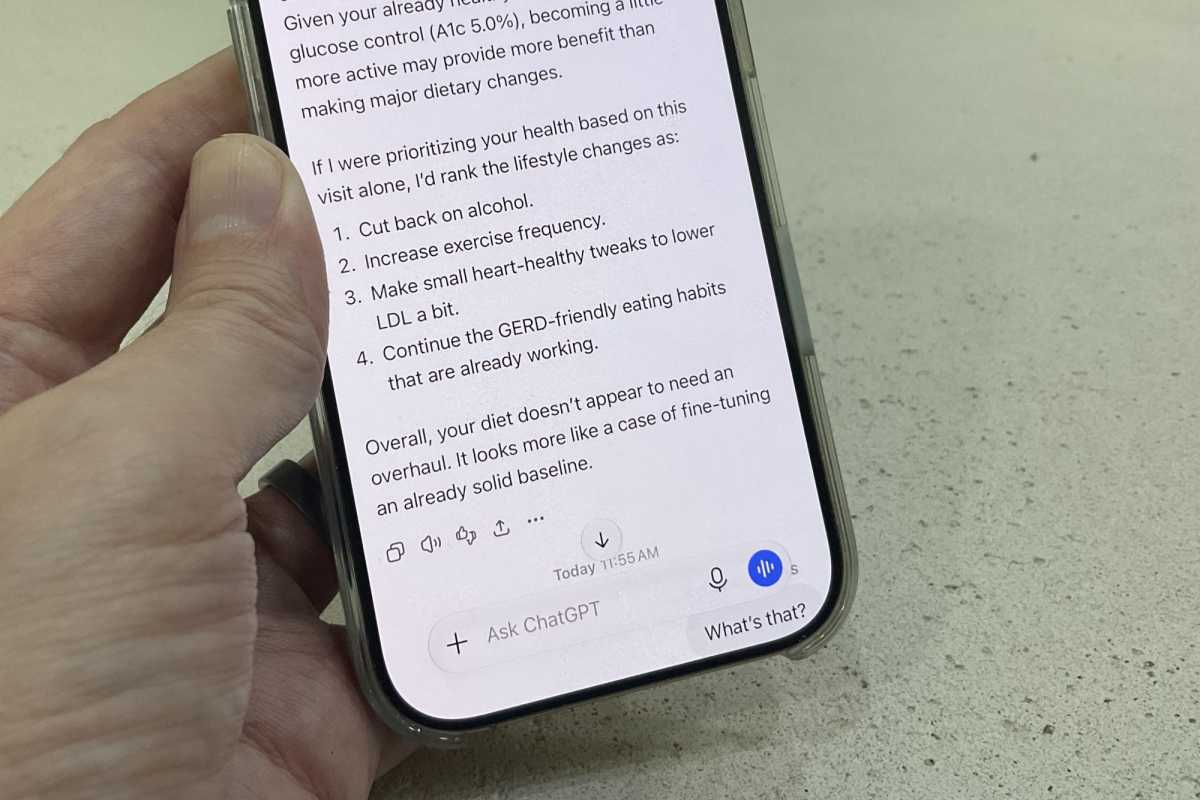
ChatGPT did give me some health tips, but nothing that wasn’t already in my doctor’s written assessment plan.
Ben Patterson/Foundry
Indeed, all of ChatGPT’s observations were grounded in my doctor’s written assessment plan — which, I’m sure, is the whole idea behind ChatGPT Health. Nothing I saw in my ChatGPT Health chats was surprising or shocking; instead, it just (as promised) gave me more context, including explanations of medical terminology that I heard my doctor use but hadn’t thought to ask about.
Now, I should point out that while I can revoke ChatGPT’s permission to access my health data at any time, my chats with ChatGPT about my health will remain unless I delete them manually, meaning you’d have to be scrupulously about pruning your past conversations to wipe your medical details completely from the chatbot’s memory. (You could, of course, restrict health-related chats to temporary conversations that are immediately deleted once closed.)
Overall, I’d call my (brief) experience with ChatGPT Health to be interesting but not all that essential. I should note that I didn’t spot anything all that dubious, with most of its judgement calls and observations quickly followed by “check with your doctor” hedging. And ChatGPT did remind me of that pneumonia shot I’m supposed to take, so that goes in the “plus” column.
But would I turn to ChatGPT if I were facing a serious medical condition? Frankly, I’d be more comfortable turning to a physician first. (Then again, my doctor did use an AI note-taking app during my exam, so…)