
SlickDeals
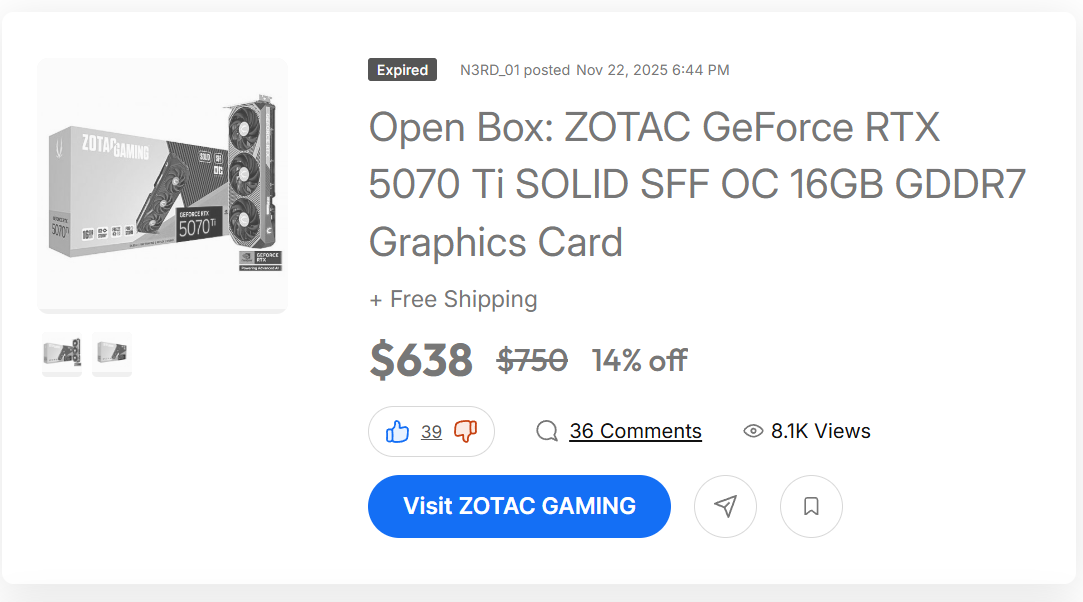
I was a little worried, too. But that $100+ discount wasn’t the only factor to consider. The same user who posted the deal pointed out that you could combine it with a PayPal holiday offer — the company’s “Pay in 4” system, split up the price over four payments with no interest. At the time, If I bought the card via PayPal and used that option, I could save an additional 20 percent as a rebate to my PayPal balance.
That brought the effective price down to $510, for a $750 card that was often hard to find for under a grand. It also came with a two-year warranty, and buying directly from Zotac meant that it would be easy enough to claim if something was off with the hardware.
I couldn’t resist, and I pulled the trigger. After three months I’d paid it off, and it’s a worthy upgrade over the 3070 I’d been using since 2021. A happy ending for a PC gamer, right? Combined with my desktop’s existing Ryzen 7800X3D and 64GB of RAM, I’ve got a setup that should last me years and years before new games start to actually push its performance limits.
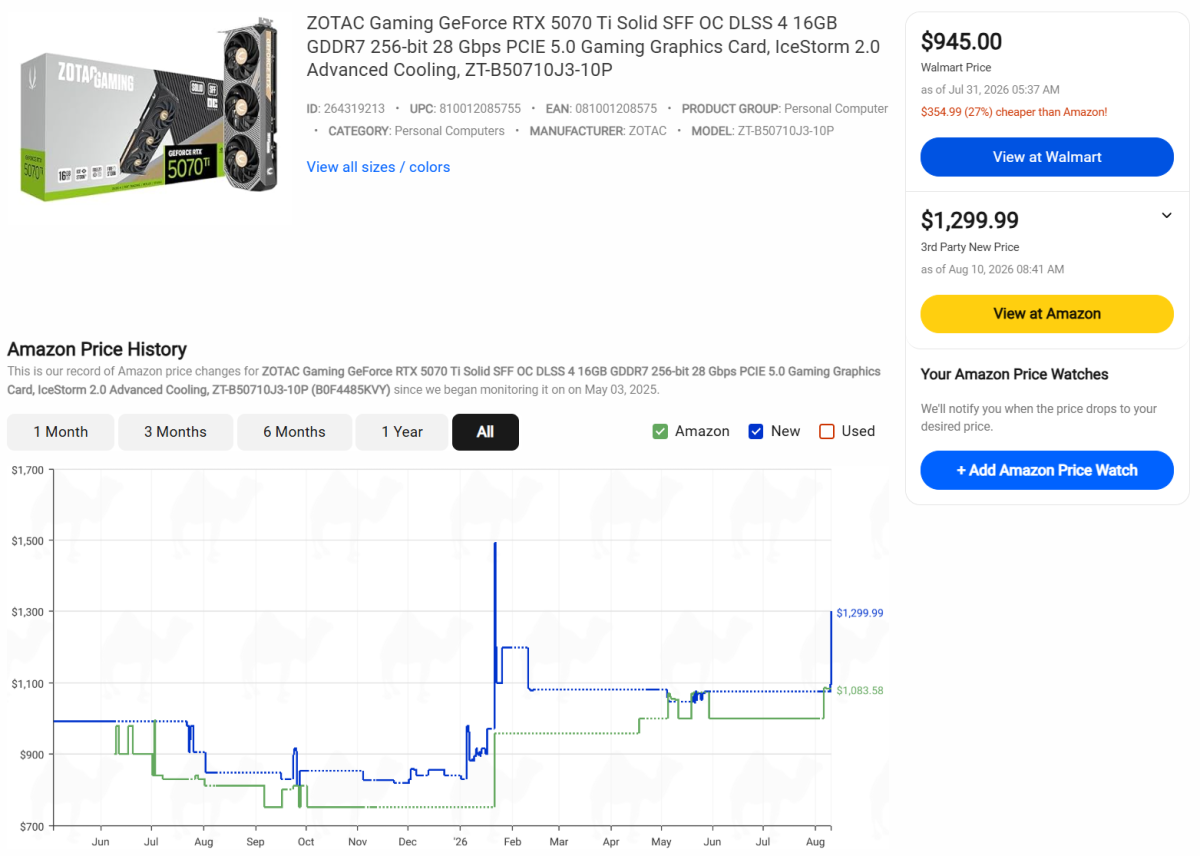
For the sake of comparison, I checked the current price on that same Zotac RTX 5070 Ti. It’s going for $1300, a $550 increase over the $750 list price from November. Ouch. (Though I’ll point out that you can find a 5070 Ti a little cheaper elsewhere.) A mid-range, pre-built gaming desktop that I recommended for a friend at around the same time was $1000, which I considered a good deal. That same machine is now $1500, a straight 50 percent increase. Similar price jumps are happening across the industry.

CamelCamelCamel
How we got here
You probably know that RAM and storage prices are incredibly inflated, about 500 percent over what they were just a year ago, because of manufacturer demand from “AI” data centers. That’s causing a lot of other problems, too, but the primary one for my job is that it’s causing a K-shaped split in the PC market, as affordable computers get less and less powerful, and powerful computers get more and more expensive.
Nvidia, AMD, and the “big three” memory producers are raking in literally trillions of dollars, but the broader PC market is suffering. Smaller manufacturers like Framework are being squeezed to the breaking point, and even giants like Lenovo and Dell are struggling. If recent reports are accurate, memory manufacturing capacity is already sold out for all of 2027. So even if the “AI” bubble pops today, we’re in for a year or more of wildly inflated prices. Other companies, notably the China-based CXMT, are trying to fill the manufacturing vacuum. But that might just slow the price problems, not reverse them.