Traditionally, a laptop’s battery life tends to be governed not by the microprocessor inside it, but by the display that you’re staring at for hours on end. That’s why a new “Oxide 1Hz” display technology from LG Display is so interesting.
As a component maker, LG will ship the panel to various customers: laptop makers, manufacturers of external displays, and so on. It’s the refresh rate that’s of interest, though: from 1Hz all the way to 120Hz. That will help save enormous amounts of power: up to 48 percent on a single charge, LG claims.
Why? Laptop panels “refresh,” or update, at various rates. Traditional TVs used panels that refreshed 60 times per second, or 60Hz. Most older laptops did too. As games became more of a focus for laptops and TVs, manufacturers turned to panels with higher refresh rates, offering smoother gameplay that matched the graphics capabilities of consoles and gaming laptops. Productivity machines also saw a boost, too: Higher refresh rates mean smoother scrolling and mousing.
There’s a tradeoff, however, for higher refresh rates: battery life. Refresh the screen more quickly, and the display chews through more power. Previously, the answer was to dynamically adjust the refresh rate, leaving it at 60Hz until the laptop saw a need for the higher refresh rate and adjusted it. More recently, laptops have taken this in the other direction, adjusting refresh rates downward to save power. Personally, 30Hz is as low I’ve seen a laptop’s refresh rate go.
LG is covering pretty much all of the bases with its Oxide 1Hz technology, offering refresh rates that can sip power at 1Hz, then dynamically support up to 120Hz when needed.
LG’s press release leaves several questions unanswered, including the source of the “Oxide” name. One question, however, has been partially solved: Which laptop maker will use it. LG is coming out and saying that it has already shipped the Oxide 1Hz panel to Dell, as part of the XPS lineup it showed off in January. (Dell shipped us a Dell XPS 14 for review, which included an OLED panel, unfortunately.) LG Display is also preparing to begin mass production of a 1Hz OLED panel incorporating the same technology in 2027.

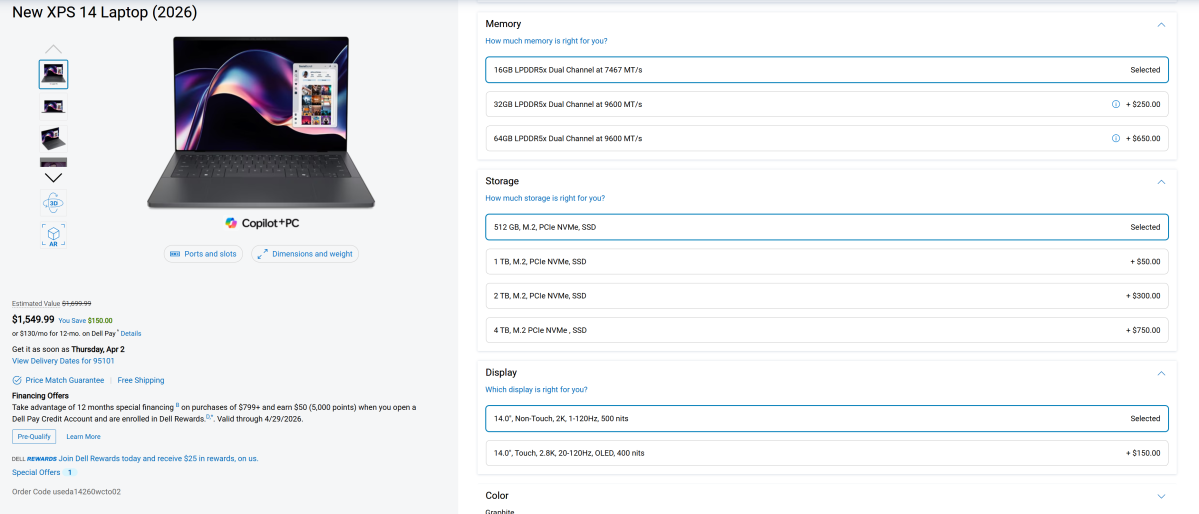
A 1Hz panel is almost, but not quite, on the level of an e-ink panel, which isn’t the prettiest to look at. LG’s panel also uses LED technology, the mainstream panel technology that’s being overtaken at the high end by OLED panels with essentially perfect contrast. How fast the Oxide 1Hz panel leaps into faster refresh rates, and whether there are any visual artifacts remains to be seen. As the screenshot above indicates, however, price doesn’t seem to be an issue; the 1Hz display is the default option.
Laptop makers have more and more options when it comes to extending battery life, including new Panther Lake processors from Intel and the upcoming Snapdragon X2 Elite from Qualcomm. Add LG’s display to the mix, and you’ll be able to work on presentations, then watch movies on the same laptop well into the evening.