
Meet Upscayl: This free AI tool turns blurry photos into high-detail images
The Upscayl tool uses several AI models to enhance your images. While unsightly edges and artefacts appear with a conventional enlargement, Upscayl reveals additional details.
This means that even slightly blurred or too-small photos can be saved. This works by the AI guessing the possible details. This is exactly what it is trained to do. Upscayl uses the Real-Esgran and Vulkan architecture.
However, this means that Upscayl requires a Vulkan-compatible GPU.
It does not work with most integrated GPUs. You can find out whether your graphics equipment is Vulkan-compatible on the website vulkan.gpuinfo.org or with the free GPU-Z tool. Most reasonably up-to-date graphics cards fulfil the requirements.
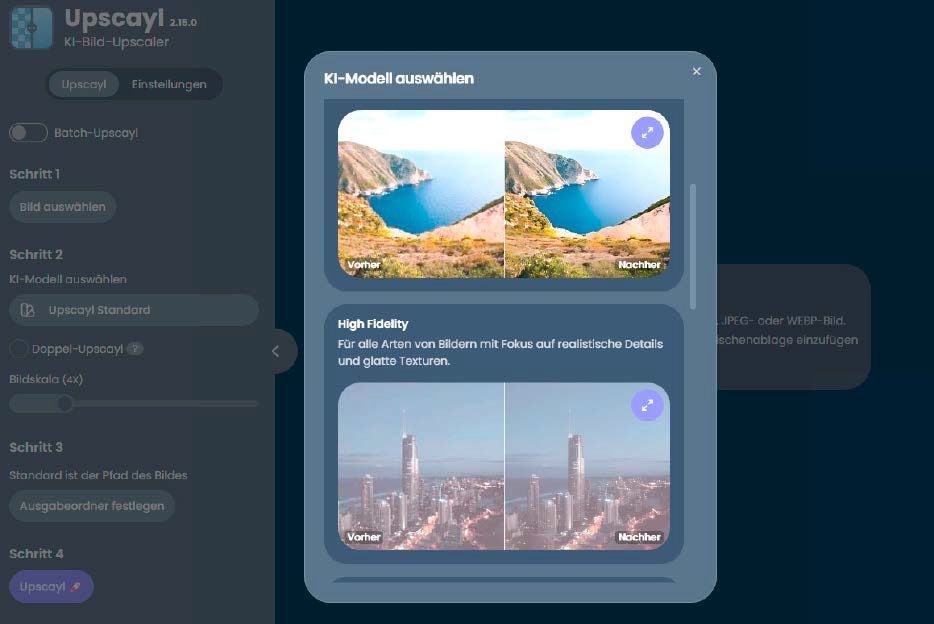
Upscayl uses several AI models with different specializations to scale and enhance images.
Foundry
The software can process various types of images, including photos, digital artwork, and even medical images. Upscaling is useful for improving quality or preparing images for printing.
Table of Contents
Installing Upscayl
The first step is to install the tool. There are corresponding setup files for Windows, Linux, and Mac. In addition to packages in DEB and RPM format, appimages, flatpaks, and snaps are also available for Linux.
The first time you start Upscayl, set the language and determine whether Upscayl should update itself automatically.
You can also select a different design if required. However, all of this can also be done later. A short introductory video follows.
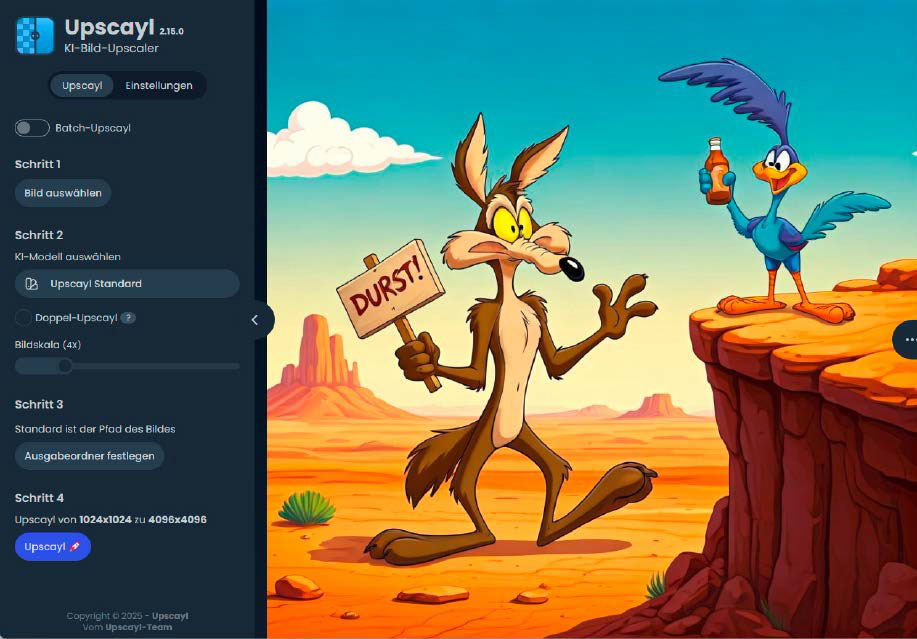
The tidy interface makes it easy to load images and scale them larger with a click of the mouse.
Foundry
Click on “Settings” at the top left to configure the tool. Here you can set a different design and specify the format in which you want to save the enlarged images.
You can also specify a fixed width. The tool then adjusts the height accordingly. It is best to leave the image compression at “0,” except for very large images, as compression is lossy and you will lose image information.
The TTA mode is interesting. This stands for “Test Time Augmentation” and is intended to deliver even better results and eliminate artefacts. The program rotates the input image eight times, generates eight different outputs, and combines them. The downside: The process takes eight times as long.
Load images and select model
Some photos are simply too small to fulfill today’s requirements in terms of resolution and quality. In the past, 640×480 pixels was considered high-resolution.
With Upscayl, photos can be enlarged quickly and additional details can be teased out. Upscayl scales low-resolution images up to 16 times larger and also improves the sharpness of the image.
There are many AI models to choose from, so you can select the perfect algorithm for your image motif.
The tool also offers batch processing, which allows you to process a folder in one go. Upscayl saves the upscaled images in either PNG, WEBP, or JPG format.
Once you have opened the program, the next step is to load the image.
The user interface is quite intuitive. You can drag and drop image files into the program window or add them using the “Select image” button. If you activate the “Batch Upscayl” slider, you specify a folder. Upscayl then scales all the images contained in it in one go.
The AI models at a glance
Now select which AI model should do the work and enlarge the image. The different models each have their own strengths.
1. The standard model is recommended for your first attempts: “Upscayl Standard” is based on Real-Esgran. This model aims to achieve high-quality results for a wide range of images. This is a good starting point for most images.
2. The “Upscayl Lite” selection prioritizes speed over image quality, although the loss of quality is rather small. It is suitable for large volumes of images or when processing time is critical.
3. The “High Fidelity” model ensures realistic details and smooth textures and is suitable for urban shots, for example.
4. The “Remacri” model is said to have the ability to improve image details and colors. It is ideal for photos with complex details or textures and brings additional sharpness to the images.
5.”Ultramix” offers a good balance between speed and image quality and between sharpness and detail. The “Ultrasharp” mode focuses on increasing sharpness, but this may come at the expense of image quality.
6. The “Digital Art” model is optimized for digital works and illustrations and aims to preserve artistic styles and details. It can also be used to scale pixel graphics. In principle, further models in NCNN format can be added to Upscayl.
Setting the magnification factor
By default, Upscayl enlarges the images to four times their original size. If you activate the “Double Upscayl” option, two passes are made, resulting in an enlargement by a factor of 16. As a rule, this does not make sense.
The slider below defines the scaling factor to values between two and 16. A high scaling factor can be useful if you want to create high-quality prints. A factor of four means that both the width and height are quadrupled. The end result is therefore 16 times the resolution.
An initial image with 2000×1200 pixels then becomes an impressive 8000×4800 pixels.
By default, the result ends up in the folder of the original, but the output folder can be specified as required. Once you have made all the settings, start the process with “Upscayl.”
How long the process takes depends largely on the performance of your graphics card. The duration ranges from less than a minute to well over an hour.
Checking the result
As soon as the processing is complete, check the new image. To compare the original and the upscaled version, Upscayl displays a slider.
Even though it may appear almost unchanged at first, the zoom reveals the differences.
Click on the three dots to adjust the zoom level or switch to a lens view. Here you will also find some statistics on how long the scaling took on average.

In the zoom view, the qualitative differences between the result file and the original are clearly visible.
Foundry
If you are not satisfied with the result, it is a good idea to try out other models. Each model has different textures and details. You will only achieve the best results after a few experiments.
