
Meta’s $18 billion payout isn’t enough to save our kids
Welcome to Safe Mode, your weekly report for pressing security and privacy news—and what steps to take next. Want this newsletter to come directly to your inbox? Sign up on our website!
A potential payout of $18 billion is on the table, with $12.7 billion in guaranteed payouts. The additional $5 billion will be paid if rivals YouTube and TikTok also agree to implement measures like a one-hour time limit, blocking late night access, and implementing age verification—plus pony up about $2.5 billion each. But Meta has also pledged reform for teen accounts of Facebook and Instagram. The biggest changes: automatically limiting teens to two hours of use per day across both platforms, muting notifications during school hours, and blocking usage from midnight through 6 a.m. Likes will also be hidden from view.
The changes are a start. But the kids may not be all right for a while longer.
For starters, these Facebook and Instagram changes are only mandated for 10 years. Meta can still serve personalized recommendations and targeted advertising too, if those features aren’t adjusted or turned off. And teens are allowed to send direct messages during school or late at night. (Meta describes this as allowing “teens to stay connected with friends and family.”)
Most parents likely won’t automatically know they have to take additional steps to more fully protect their kids—that unless they actively poke at Facebook and Instagram settings and monitor account use, those teens could still be exposed to harmful material or conversations. For example: A feed with only content from followed accounts will be available to teens, but only if selected as the default. And bullying can still happen over direct messages.
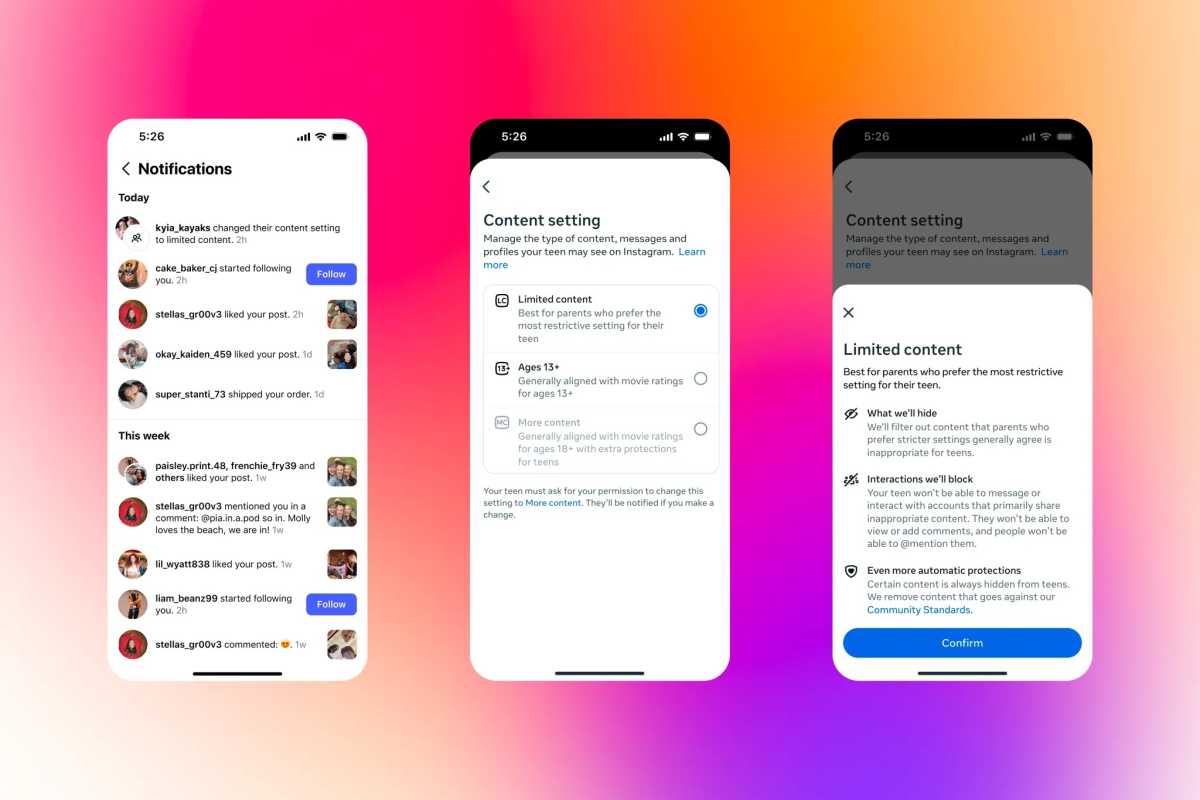
Meta says the new restrictions on teen accounts will release alongside existing parental management tools.
Meta
I’m also concerned about how Meta will ensure teens don’t circumvent these restrictions. The company doesn’t want to manage the age verification process directly. Instead, Meta is advocating for age verification to be performed by app stores. But that creates a whole new set of problems. First, the basic privacy risks: What documentation will be required for verification? Who will process the applications? Will biometrics be involved? How will all the data be stored? Who will have access to that data? And second: Will all apps in an app store have access to that data? Could a shady developer purposely target the under-18 crowd?
Plus, age verification in general is a mess, and will be a mess for a while longer. Governments have begun passing legislation requiring it, but without a true understanding of how to implement it effectively. (My own state of California came out with a shockingly bad take on this, to the point where free software like Linux could have been affected.)
