
Microsoft outs Xbox Project Helix: ‘We want to break down the artificial barriers between PC and console’
Microsoft unveiled more details of its “Project Helix” next-generation console at the Game Developer Conference, and they should look familiar to PC gamers.
And we nearly have a launch date: Alpha versions of the Helix console will be sent to developers in 2027, Microsoft executives said. Microsoft also said that its “Xbox Mode” would be transitioning from the handheld to all of Windows PCs beginning in April this year.
Helix will be “aligned” to allow customers to play both Xbox and PC games, “providing the ultimate player-first experience,” a top executive said.
Microsoft has said little about its upcoming console plans since announcing a change in leadership that saw former Xbox leaders Phil Spencer and Sarah Bond replaced by Asha Sharma as the executive vice president on charge of Xbox Gaming. Sharma announced Microsoft’s plans for Project Helix, the next gaming console in Microsoft’s lineup. Microsoft had yet to talk substantively about the device before today, however.
Jason Ronald, who was introduced as the “vice president of Next Generation” at Microsoft, demonstrated how Helix represented the evolution of Microsoft’s console, explaining some what Microsoft wants to accomplish in terms of technology and features.
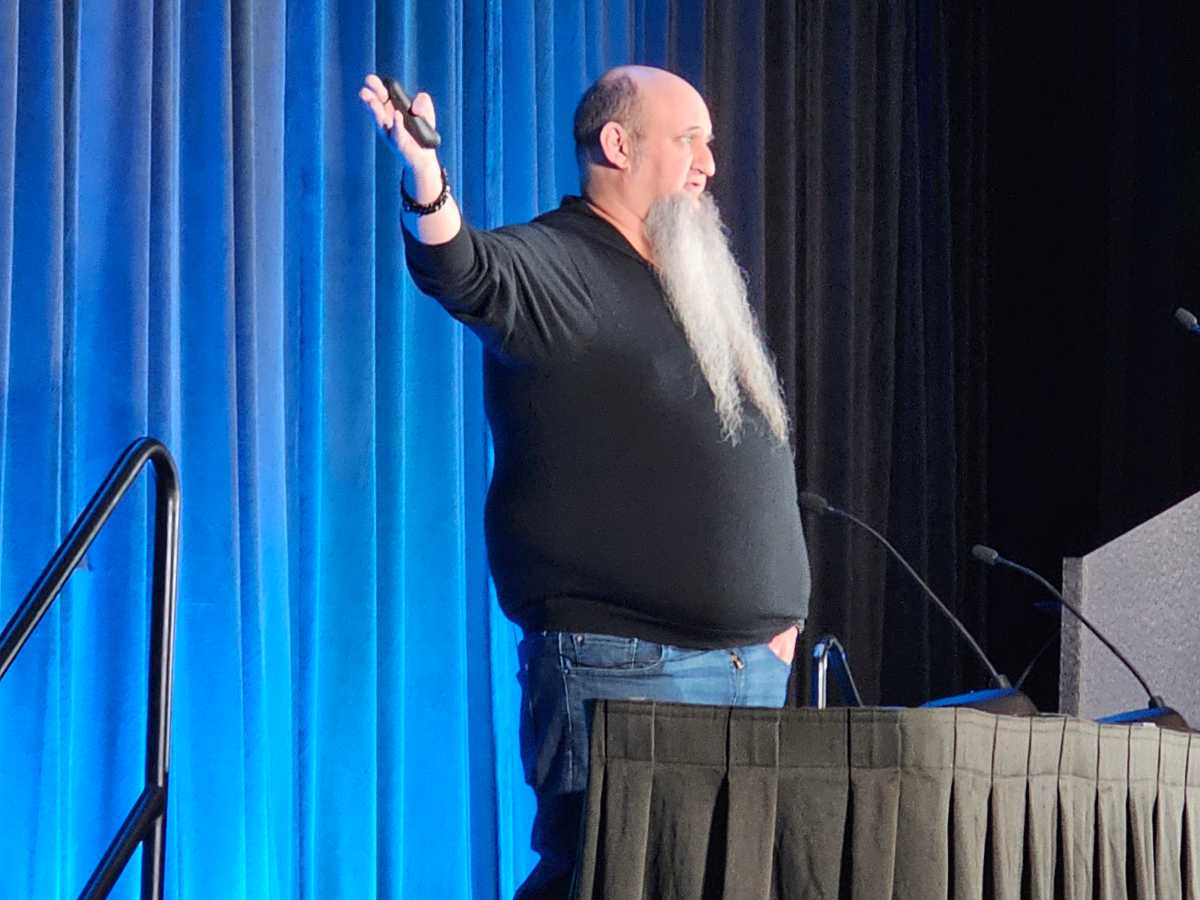
Mark Hachman / Foundry
“When we released the original Xbox we imagined it as the premium living room gaming experience,” Ronald said, with a hard drive and a 56Kbps modem, and an online community with Xbox Live. In 2005 Microsoft launched the Xbox 360, followed by the Xbox One and the Series X.
Most of the recent development work has been with AMD, who has co-designed the system-on-a-chip (SOC) components at the heart of Xbox consoles, but also its competitors. The goal now is to design a family of silicon that can work across a family of devices, Ronald said, where consumers “have confidence in games” and that “they will run on a wide diversity of devices.”
Familiar features that now appear on the PC will make their way to the console, Ronald said. That includes next-generation ray tracing, plus neural rendering techniques like upscaling and multi-frame generation. Helix will also include “next-gen ray regeneration” for the console, including path tracing. Unfortunately, Ronald didn’t characterize the performance of these features, such as how many AI-rendered frames the SOC will be able to inject.

Mark Hachman / Foundry
Finally, there’s deep texture compression, which is a brand new technique. Helix will also take advantage of DirectStorage to stream game data from the storage mechanism, like an SSD.
Breaking down the barriers
It’s also time to abandon the concept of “PC gamers,” and “console gamers,” Ronald said. “We want to break down the artificial barriers between PC and console games,” Ronald said.
PC is also becoming an integral part of gaming, Ronald said.
An early version of this is the Asus ROG Xbox Ally, Ronald said, which is powered by Windows, but gamers don’t see the Windows interface. Microsoft is constantly iterating with features like Auto Super Resolution, shader delivery, and “highlight reels” as part of its ongoing development, Ronald said. Again, the Xbox Fullscreen Experience will come to all Windows PCs in April.

Mark Hachman / Foundry
Ronald mentioned several times that customers want a “consistent experience,” regardless of the platform, where users don’t have to “fight the [user interface].”
A key element of Xbox Play Anywhere is cross-platform integration, progression, and entitlement, where players own both “console” and “PC” versions of the game, but also progress uniformly across both platforms. (That requires games being saved to the Xbox cloud.)
Microsoft also believes in game preservation, where older games are not only maintained but can be played in new ways, Ronald said.
The future of Xbox is the console (“It’s who we are, and it will always be around,” Ronald said) as well as the handheld. (The PC wasn’t mentioned.) Microsoft is also trying to drive deeper into the accessory space.
“Ultimately, however, it’s all founded in incredible games,” Ronald said.
Updated at 11:23 AM with more details.
