
My new Steam Machine is adorably disappointing
Summary created by Smart Answers AI
Table of Contents
In summary:
- PCWorld reviews the new Steam Machine, a compact 6-inch cube gaming console running SteamOS that costs over $1,000 but delivers PS5-comparable performance at nearly double the price.
- The device excels with 2D games and older titles at 4K but struggles with demanding games like Space Marine 2, requiring 1080p resolution for playable framerates.
- Despite SteamOS maturing into a user-friendly platform, the Steam Machine offers poor value compared to consoles or custom PCs at similar prices.
I got my Steam Machine this week. I kind of love it. And I’m still disappointed in it. It might be unfair to assign blame to Valve for the woes of the PC hardware world right now…but fair or not, the Steam Machine just doesn’t make sense at its price, either as an accessible gaming PC or an alternative to game consoles.
The good stuff: Easy access to SteamOS and my Steam library
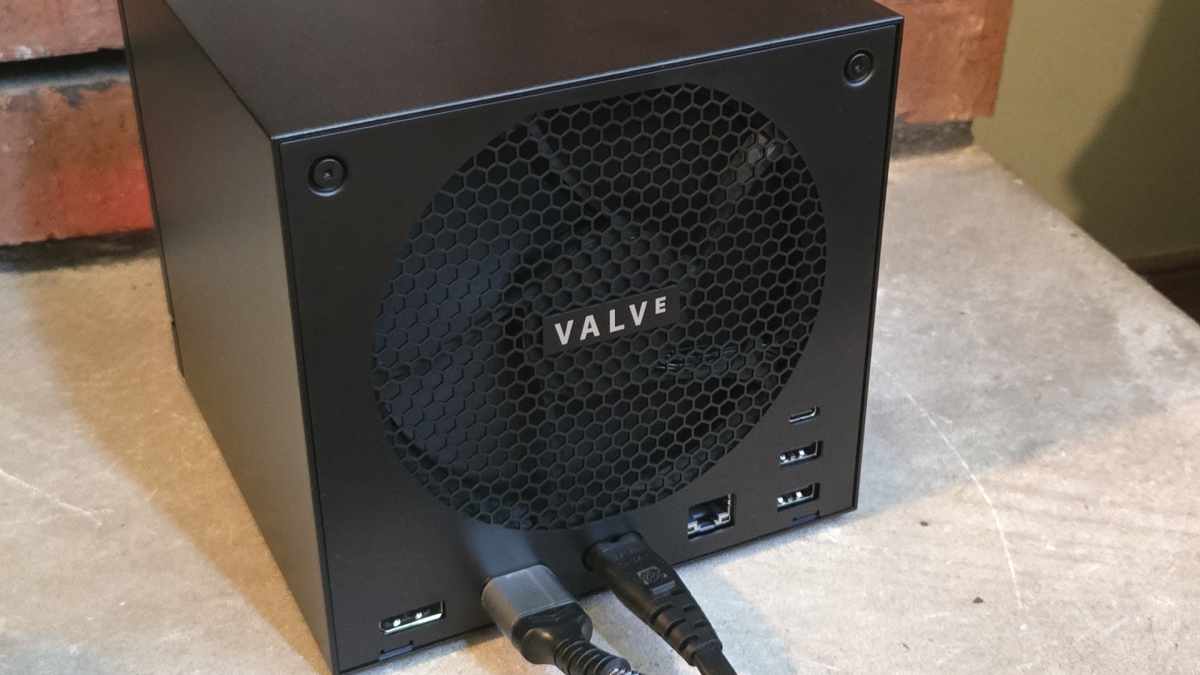
The Steam Machine is adorable. It’s a 6-inch cube, black out of the box, with a little bit of character coming from a swappable plastic face plate and an LED indicator bar at the bottom. (Which I immediately set to pulse like a Cylon from Battlestar.) This thing looks like my gaming PC and my GameCube from 2001 had a baby. Thanks to the understated looks it’ll fit right in with an office setup (it’s essentially a chunky mini PC) or a sleek entertainment center. But you can bling it out with a custom face plate if you want — I’ve been eyeing this 3D printed “GabeCube” design on Etsy.
Michael Crider / Foundry
The console-style setup is also shockingly smooth. Plug it into power and HDMI, attach a controller, and walk through a Wi-Fi connection and a Steam login. While I was a bit dismayed to see the usual PC-style automatic updates for both the Steam Machine and the Steam Controller, that’s just kind of the way things work these days. In less than 20 minutes I was downloading games — I started with Hades II — and waiting for others to download in the background. The setup process feels more or less identical to the one I remember from my first boot of the PS5 about four years ago.
The biggest difference from that experience is that I think the Steam Machine is a little smaller than my chunky PS5. Perhaps that’s not a fair comparison, since the PS5 has a disc drive…but it also has an APU setup and isn’t nearly as accessible in terms of the hardware. The Steam Machine is also insanely quiet. Even when blasting it with the most graphics-heavy games, I could barely hear it operating from a few feet away. To borrow a phrase from one of my favorite bits of tech writing, a review for the GameCube in Electronic Gaming Monthly, it is “mouse-fart quiet.”
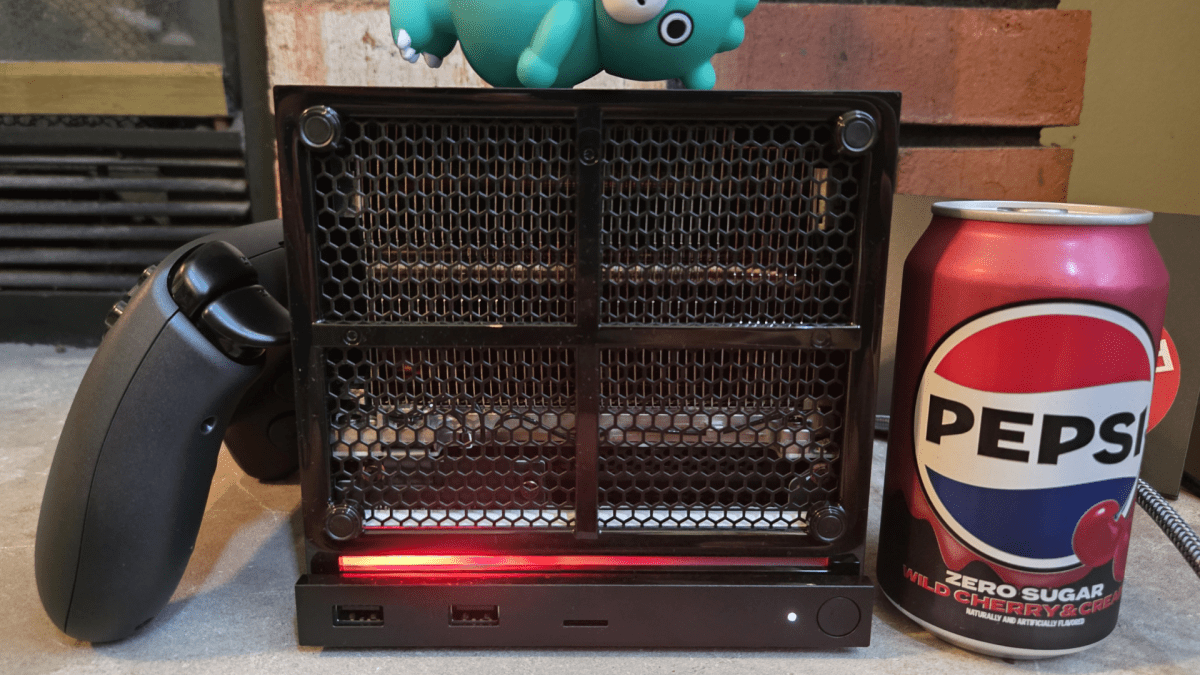
No wonder it’s quiet, this little thing is 80% cooling by volume.
Michael Crider / Foundry
If you’ve played around with a Steam Deck, or rolled your own, this will all feel very familiar. Valve has done an impressive job on both the Steam platform itself and SteamOS to make the system smooth and seamless. With the addition of the Steam Controller it’s even better, though any standard Xbox-compatible pad will work fine if you don’t need the touchpads or gyro controls.
Performance — some highs and lows
I started up a new run in Absolum, one of my favorites from last year, as a test of general vibes. I’ve gone through this game all the way sitting at my desk. The art in this title is absolutely gorgeous, but it’s also fully 2D, or the kind of 3D that’s so subtle it’s practically invisible. Predictably, the Steam Machine with its mid-range AMD CPU and discrete GPU managed to handle this game at 4K without any hiccups at all.

Michael Crider / Foundry
That’s not a shock. Hades II is at about the same technical level, and it’s got a fair bit of 3D models and effects on the screen. Less demanding 3D games were also buttery smooth — and God of Weapons actually worked better on the Steam Machine than my fancy gaming PC, because something about my Windows setup never let me get a controller to work. On SteamOS, it never missed a beat. Time for something a little more challenging.
I threw one of my favorite open-world games at the Steam Machine: Horizon: Zero Dawn. This was a showpiece for the PS4 back in the day, and the PS5 remaster got a PC port that’s absolutely gorgeous. It’s also shockingly well-optimized, running on handhelds without too many problems. And it does well on the Steam Machine, too. Pumping up the resolution to 4K and setting the visuals to high, I also popped on AMD FSR, because this kind of cinematic showpiece is exactly what that tech was designed for. The Steam Machine handled it even better than I expected, managing 59 FPS on the built-in benchmark and consistent 50-60 FPS in the open-world game fighting its complex robot monsters.

Michael Crider / Foundry
Time to pick up the pace. I loaded up my favorite new game from this year, Dead as Disco. This is an Unreal Engine 5 game that features small arenas and only a dozen or so characters onscreen at a time, but pumps up the effects to give extra vibes to its musical beat-em-up gameplay. It’s also a great example of how stability and smoothness is important for gaming; a few jitters is all it takes to throw off your groove. This was the first one that struggled at 4K, dipping down into the 30-45 FPS range, and making me a little less lethal on the dance floor.

Michael Crider / Foundry
For an ideal mix of graphics and performance, I had to bump it down to 1080p, a real shame on my fancy LG OLED. The first compromise, but not the last. The current “big gun” in my Steam library is, appropriately, Space Marine 2. This 2024 title is brimming with real-time action, has hundreds of creatures onscreen at once, and absolutely blasts you with every graphical flourish. At the default auto settings it just about managed to hit 60 FPS in the intro mission.
Then I pumped it up to 4K, as the settings had chosen 1080p for the Steam Machine. And yeah, that was probably the right call, settings menu. Because at 4K, Space Marine II rolled a 2 on its 3 up armor save. It slowed down to about 15-20 FPS, seriously impacting gameplay. With a bit of coaxing in the graphics menu I was able to bring that up to about 30…which still isn’t great, especially if you want in on the multiplayer. 1080p it is.

I’m not even crushing any heretics under my authoritarian boot in this screenshot, and I’m only getting 17 FPS at 4K.
Michael Crider / Foundry
These results are about what I expected, given the hardware on offer, which has only gotten worse since the Steam Machine’s announcement, with a disheartening single-channel RAM downgrade. In terms of the competition, it’s at approximately PS5 level…despite costing a little less than double at the base configuration for both.
This isn’t an apples-to-apples comparison, for a lot of reasons — Steam has PlayStation beaten for game choice by an order of magnitude, for example. But paying almost twice as much for similar performance doesn’t look good any way you qualify it.
SteamOS is great. I genuinely think it might be the future of PC gaming. But it’s also still pretty firmly on the “PC” side of the PC-console divide. Despite years of work from Valve, there are still a few foibles that need to be addressed.
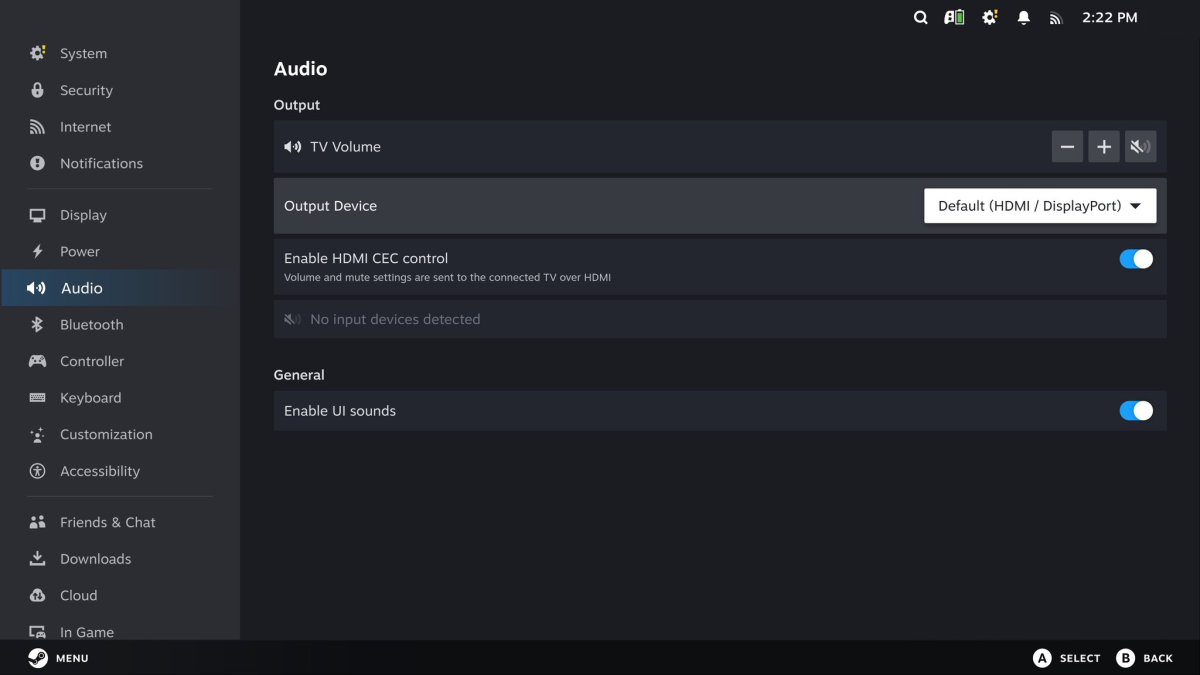
For example, plugging my Steam Machine into my TV, I was expecting it to work with a surround sound system out of the box. It does…sort of…I think. I’m getting sound out of the rear speakers, but they don’t seem to be actually mapping to surround sound in any of the games I tried. I peek into the SteamOS settings menu and…it just says that sound is outputting over HDMI. Individual game settings are less than helpful.
Michael Crider / Foundry
This is a problem I could probably fix with a good bit of extra legwork. But I shouldn’t have to — if Valve is positioning this as a gaming device for your living room, it should work automatically, maybe with five minutes of settings tweaks. It works that way for the PS5. And the Steam Machine is missing some of the go-to tools for an entertainment center device. I can’t load up Netflix or Disney+, for example, not without popping out to a browser.
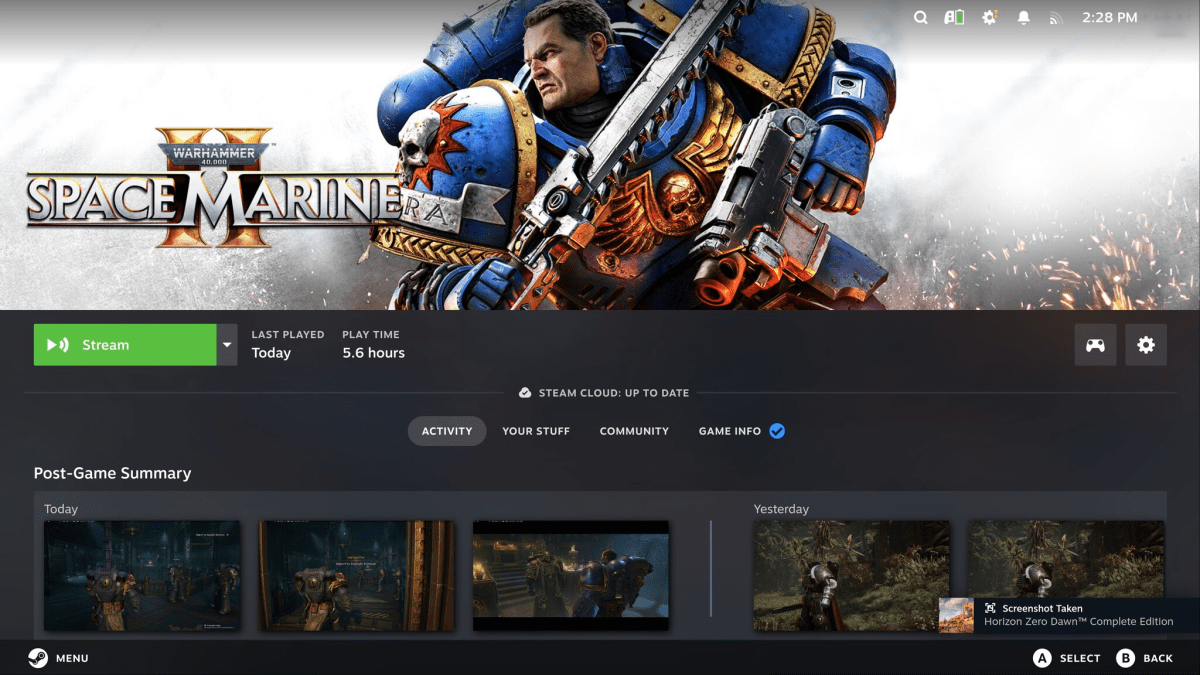
But that’s leaning more on the console side of things. I decided to lean into the PC gaming angle. I’ve got a pretty beefy PC in my office, and SteamOS has local streaming baked right into it. That thing can play Space Marine 2 at full blast and easily max out my 240Hz, 3440×1440 monitor. Why not just play it remotely?
“Because there’s a 2-year-old bug that doesn’t let you stream Space Marine 2 via Steam,” that’s why. I began streaming the game, and it defaulted to my PC’s ultrawide resolution. Not ideal, but that’s fixable in a variety of ways. But I can’t fix it if I can’t control the game. And I can’t, because remote gamepad inputs just don’t work, and haven’t since launch. This isn’t some obscure indie game, it was a smash hit, and its multiplayer community is still strong enough that it’s getting regular content updates. I guess there just aren’t enough people playing the game in this way for it to matter.
Michael Crider / Foundry
Streaming other games was, well, doable. Even without that annoying controller bug (which is more on the game developers than the device), getting other games over to the TV from my gaming PC was a hassle. I had to manage settings much more carefully; there was no way to set things up to full 4K since my monitors max out at 1440p, and the obvious latency hit wasn’t great for games like Dead as Disco. This just isn’t a great way to experience PC games, even if it was nice to see them on the big screen.
The ideal Steam Machine game, therefore, is something that doesn’t push the envelope too hard on 3D visuals. And that is a damning statement for a product that’s professing to bring PC gaming to the living room.
The worse stuff: A horrible value
The elephant in the room for the Steam Machine has always been its price. Even before “AI” absolutely massacred PC hardware, back when we assumed it would be somewhere in the $600-900 range, that was a big chunk of change for either a console or a medium-power gaming PC. At $1,050 — and I’m assuming Valve pinched every penny it could and failed to get it down to $999 — it just looks bad.
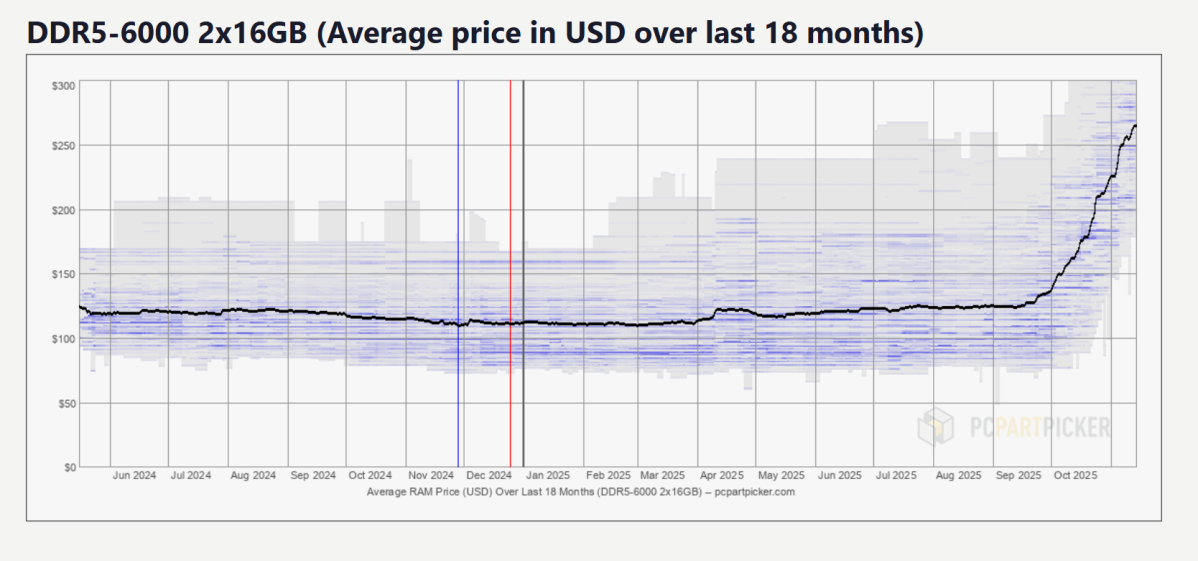
It’s not Valve’s fault that 2026 is a blighted hellscape. (And also RAM is really expensive, ha-cha-cha.) But you can’t tell regular buyers, who are already struggling, to look at a bigger market picture. $1,000+ for a mid-range gaming PC, and one that isn’t well-suited to regular PC tasks, is not a good proposition. Sure, you could load up a regular Linux desktop, install a browser, and treat this like a regular PC. But why would you, when you can get a Windows machine that’s as capable for the same price, or less?
PCPartPicker.com
While I’m sure Linux fans and SteamOS faithful would be willing to make that argument, for the average person who just wants to play some games, I just can’t. I’m just going to come out and say it: If you’re looking to play video games and you’re starting from square one, a PlayStation 5 or a Switch 2 is a better buy. Even ignoring their various exclusive games, it’s easier and cheaper, and the extra homework that comes with SteamOS might be off-putting in its own way.
So who is the Steam Machine for? (Aside from tech journalists who want to poke at it, like me, I suppose.) Taking Valve at its word, the Steam Machine is for someone with a huge Steam library who wants an easy way to play those games on their TV. And for that, it works…with important exceptions, like playing the latest games at 4K. And you’re paying a lot for that.
For the sake of comparison, my current gaming PC (7800X3D/5070 Ti) would cost about $2,600 to build today, maybe $1,700 before all this “AI” nonsense blew up the market. And it can play Space Marine 2 with approximately four times the performance of the Steam Machine, at 2.5 times the price. The Steam Machine is a bad value any way you slice it.
SteamOS is the star
All that being said, I’m still bullish on one part of the Steam Machine: its operating system. What was a pipe dream with the original Steam Machine(s) a decade ago has matured into a true gaming-focused Linux build, and one that’s approachable for mainstream users. It’s not perfectly polished at every angle, but then, neither is Windows. And this is built from the ground up for gaming.
Valve seems to agree with me, since it’s now letting you load up official builds of SteamOS on home-built PCs, no Bazzite distros required. There’s still a lot of support that needs to be fleshed out, most immediately with Intel and Nvidia hardware…but they’re working on that, too. And with the Steam Frame coming soon, it looks like SteamOS is going to invade Arm-based hardware too. That is genuinely exciting.

Michael Crider / Foundry
We’re starting to see gaming PC hardware pop out with SteamOS pre-installed, no Windows to be seen anywhere. We’ve already gotten one such device from Lenovo, one of the biggest PC manufacturers on the planet, in the SteamOS flavor of the Legion Go. There are rumblings of smaller companies pulling similar moves. But I think we’re only a year or so away from a gaming laptop being sold at Best Buy with a Linux operating system (if not a truly “free and open-source one”).
In the meantime…yeah, don’t buy the Steam Machine. It just doesn’t make sense right now, but in this market, it’s hardly alone in that regard. For the kind of games that the Steam Machine excells at, I’d buy a cheaper mini PC and load up SteamOS. (Or, you know, just run Windows and Steam in Big Picture Mode.) Alternately if you have a laptop you’re not using it could probably do the same thing. If you can get your hands on a Steam Controller that would get you almost all the way there… though an Xbox pad is probably a more realistic option right now.
The Steam Machine is exciting, for what it represents if not for what it actually is. I might sell it in a few months after I’m done poking at it, or I might keep it around just as an easy way to see what Valve is doing with SteamOS. But that’s literally part of my job. For those who just want to play games, I think you might want to let that purchase invite pass you buy.
