
Social media is being slammed by deceptive AI videos. Here’s how to spot them
Sora2 is the latest video AI model from OpenAI. The system generates completely artificial short videos from text, images, or brief voice input.
Since October 2025, there has also been API access that developers can use to automatically create and publish AI videos. As a result, the number of artificial clips continues to grow every day.
Many of them look astonishingly real and are almost indistinguishable from real footage for users. In this article, we show you how to reliably identify AI videos despite their realistic appearance.
Table of Contents


How to recognize deepfake AI videos on social networks
AI videos from Sora2 often look deceptively real. Nevertheless, there are several clues that you can use to reliably recognize artificially generated clips. Some of them are immediately obvious, others can only be recognized on closer inspection. On the subject of deepfakes, we also recommend: One simple question can stop a deepfake scammer immediately
Unnatural movements and small glitches
AI models still have problems with complex movement sequences. Watch out for:
- unnaturally flexible arms or body parts
- Movements that stop abruptly or are jerky
- Hands or faces that flicker briefly or become deformed
- People who disappear briefly in the picture or interact incorrectly with objects
Such distortions are typical artefacts that still occur in AI videos. Here is an example of a school of dolphins. Pay attention to the unnatural swimming movements and the sudden appearance (glitch) of the orcas. The hands of the woman with the blue jacket are also hallucinated:
Inconsistent details in the background
Backgrounds that do not remain stable are a frequent indicator. Objects change shape or position, texts on walls become a jumble of letters or cannot be read. Light sources also sometimes change implausibly.
Very short video lengths
Many generated clips in Sora2 are currently only a few seconds long. Most AI videos circulating on social media are in the range of 3 to 10 seconds. Longer, continuously stable scenes are possible, but still rare.
Faulty physics
Watch out for movements that are not physically plausible. For example, clothing that blows the wrong way in the wind, water that behaves unnaturally, or footsteps without the right shadows and ground contact. Sora2 produces very fluid animations, but the physics still betray some scenes.
Unrealistic textures or skin details
In close-up shots, it is often noticeable that skin pores appear too smooth, too symmetrical, or too plastic. Hair can also appear unclean at the edges or move in an unnaturally uniform way.
Strange eye and gaze movements
Even if Sora2 simulates faces impressively realistically, eyes often make mistakes. Typical examples are infrequent or uneven blinking, pupils that change their size incorrectly, or glances that do not logically follow the action. If a face appears “empty” or the eyes are slightly misaligned, special care is required.
Soundtracks that are too sterile
Sora2 not only generates images, but also audio. Many clips have extremely clean soundtracks without background noise, room reverberation, or random noises such as footsteps, rustling, or wind. Voices sometimes sound unusually clear or seem detached from the room. Sound errors where mouth movements do not match the voice are also a clear indication.
Check metadata
Open the video description of the YouTube shorts by tapping on the three dots at the top right and “Description.” YouTube provides additional information about the origin of the clip there. Particularly in the case of artificially created videos, you will often find entries such as:
Audio or visual content has been heavily edited or digitally generated.
In some cases, the note “Info from OpenAI” also appears. This is a strong indication that the clip was created with Sora2 or a related OpenAI model. This information is not always available, but when it does appear, it provides valuable information about the AI origin of a video.
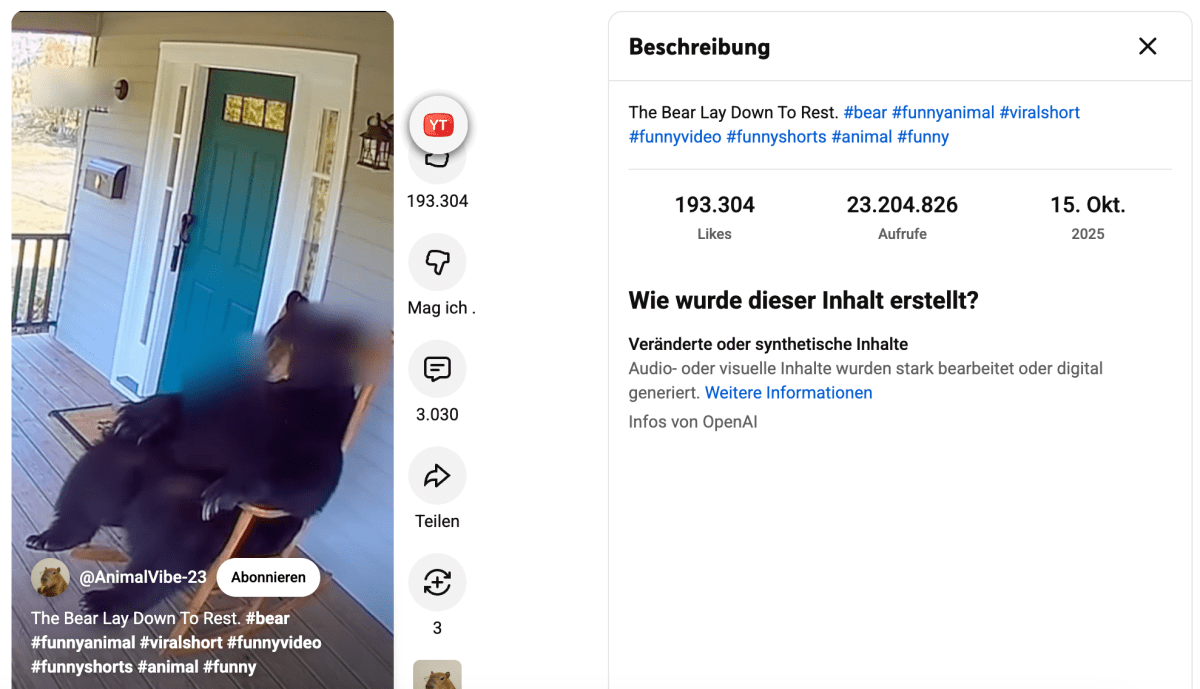
You will often find references to AI in the video description. In this case, OpenAI is even explicitly mentioned.
PC-Welt
You can also use tools such as https://verify.contentauthenticity.org/ to check whether the video contains C2PA metadata. However, this information is not always preserved. As soon as a clip is saved again, trimmed, converted, filtered, or uploaded via another platform, the digital origin data is often lost.
Pay attention to watermarks
Sora2 sets an animated watermark in the video (see example). However, this is often missing on social networks. Users remove it or simply cut it out. The absence of a watermark therefore does not mean that a video is genuine.
Don’t ignore your gut feeling
If a clip looks “too perfect” or people do things that seem unusual or unlikely, it is worth taking a second look. Many deepfakes only become apparent because of this subtle inconsistency.
Risks for politics, celebrities, and everyday life
With Sora2, the deepfake problem is getting noticeably worse. AI researcher Hany Farid from the University of California, Berkeley, has been warning for years about the political explosive power of deceptively real AI videos. According to Farid, a single image and a few seconds of voice recording are enough to create realistic video sequences of a person.
This is particularly critical for the political public. This is because the increasing spread of artificial clips means that even real recordings can be called into question. In a recent Spiegel interview, Farid puts it like this:
“If a politician actually says something inappropriate or illegal, they can claim it’s fake. So you can suddenly doubt things that are real. Why should you believe that when you’ve seen all this fake content? That’s where the real danger lies: If your social media feed, your main source of information, is a combination of real and fake content, the whole world becomes suspicious.”
Celebrities and private individuals are also increasingly being targeted. Fake confessions, manipulated scene videos, or compromising clips can be used specifically to blackmail or damage reputations. In the corporate context, additional risks arise from deepfake voices or fake video instructions from supposed managers.
Farid’s assessment: The technical quality of AI videos is improving faster than the ability to reliably expose them. This loss of trust in visual evidence is one of the biggest challenges of the coming years.


