In April, I had a chance to try out the new haptics inside the Windows 11 Insider Build 26300.8155, which Microsoft was showing off with a prototype mouse at the time. Haptics, sometimes called force feedback, vibrate and “push back” against your fingers to provide tactile feedback.
Some Surface laptops, such as the Surface Laptop Studio 2, have included haptic trackpads for years, as an alternative to the traditional mechanical trackpads that need to be depressed, and whose “clickability” extends only over part of the surface. I’ve always found these trackpads to be particularly useful, as you don’t need to “aim” your finger at a portion of the trackpad.
The Surface Mouse — and the Logitech MX Master 4 for the PC and Mac, the ultimate productivity mouse — now support these haptic features as well. Aligning objects in PowerPoint, window snapping, resizing, or hovering over the Close button will all trigger some vibration on the mouse, as well as presumably the existing trackpads as well. (Dragging and dropping files will also eventually buzz your fingers, too.) Logitech’s mice also include the option to turn on additional haptic features via its Actions Ring and Smart Actions, as well as when your mouse is searching for a host via Bluetooth or when it connects.

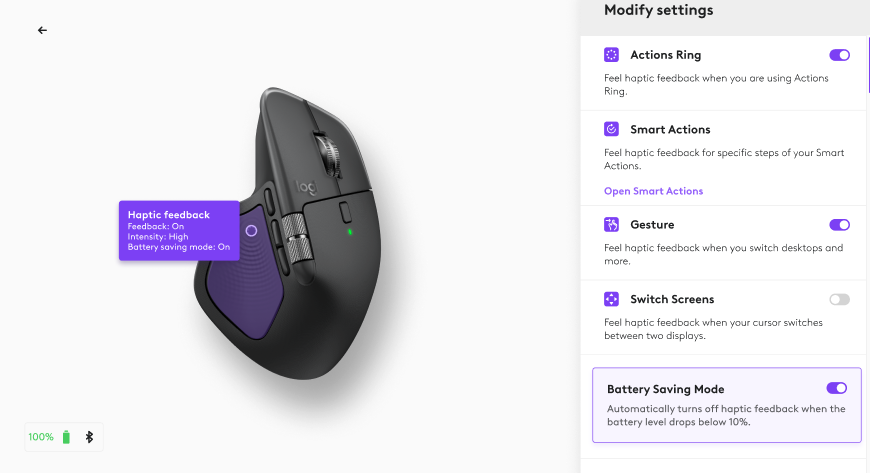
Logitech’s haptics trigger as part of the thumb rest; it’s not clear where Microsoft’s Surface Mouse will conceal its haptic feedback. (I can’t recall where the feedback was when I tried out the haptics several months ago.)
Don’t get me wrong: I think haptic touchpads are useful, as they extend the touchpad’s useful surface. I’m less confident about haptics inside a desktop mouse.
In a desktop mouse, haptics felt less productive and more of a convenience. A car’s purpose is to transport you from point A to B; there, haptics felt more like a rear-window wiper. Useful? Yes. Necessary? Not for me. The Microsoft representative showing them to me tried to position them as something you’d adjust to quickly, and would miss if they were taken away. I’d even agree! But it still felt like a convenience, rather than a necessity. I can visually see when a window expands, and I can click a window closed without any tactile confirmation.