Summary created by Smart Answers AI
Table of Contents
In summary:
- PCWorld reports that Microsoft is raising Surface laptop prices due to soaring memory and storage costs, while Apple’s new $599 MacBook Neo offers competitive productivity at a lower price point.
- Apple’s vertical integration and use of its own A18 Pro chips enables greater cost control and pricing flexibility compared to Microsoft’s reliance on third-party components.
- The MacBook Neo’s A18 Pro processor significantly outperforms Intel alternatives in benchmarks, positioning it as a strong budget-friendly option against increasingly expensive PC alternatives.
Apple’s $599 MacBook Neo is arriving just as laptop makers are making productivity more expensive. Microsoft bumped up prices on its Surface lineup this week, and other PC manufacturers are under pressure from rising costs for memory, storage, and even Intel processors. Apple is moving the other way, offering a lower-cost laptop that still promises enough performance for the work most people do every day.
The MacBook Neo zigs where normally Apple zags: Instead of shipping a premium product at a premium price, Apple stole a page from budget PC vendors and started cutting corners to save money. The MacBook Neo’s A18 Pro phone processor is simply closer to a Chromebook — but with the branding and performance of a more expensive device.
But that pricing gap reflects more than marketing. Analysts told PCWorld that Apple can make productivity cheaper because it controls more of the product stack, from chip design to hardware integration, giving it flexibility that Microsoft and other PC makers simply do not have. The result is the MacBook Neo: A laptop built to do more with less, at a time when the rest of the PC market is charging more for the same basic promise.


Foundry
PC performance at a fraction of the price
Honestly, Microsoft’s Surface lineup may not be the best comparison for Apple’s laptop.
“If you think of the Neo as a higher-end Chromebook class system, it makes a lot more sense. Surfaces aren’t in the same category,” Dean McCarron, an analyst at Mercury Research, said via email.
“It’s pretty easy to see how Apple hit the lower price point,” McCarron continued. “Chromebooks are more expensive now, too, but the median price is about $500 for [an Intel] N100/N150 [Chromebook processor] and $370 for a Mediatek based system; upgrade the RAM and SSD and screen and you’re at Neo levels on specs and price. Surface pricing is a wide range due to options but the median is around $1,500.”
For the chips alone, an N100/150 typically costs under $35 “and may be even half that,” McCarron said. The Surface’s Qualcomm Snapdragon X Elite or Intel’s Core Ultra Series 2 (Lunar Lake) chips both “are well over $100” in price, he said.

Michael Crider / Foundry
There’s more. Since Apple designed and commissioned the A18 Pro itself, it can save money on each individual chip. Chipmakers like Apple pay for individual silicon costs, though it’s not clear how much; that depends on the actual size of the chip and the process technology used.
It’s not clear whether Apple actually paid for “extra” A18 Pro chips to manufacture the Neo, or if this was part of a stockpile it had bought, but never used. Either way, it was already bought and paid for. Ben Thompson’s Stratechery (cited here) even hypothesizes that Apple may be using “binned” or rejected chips inside the Neo, making them essentially free!
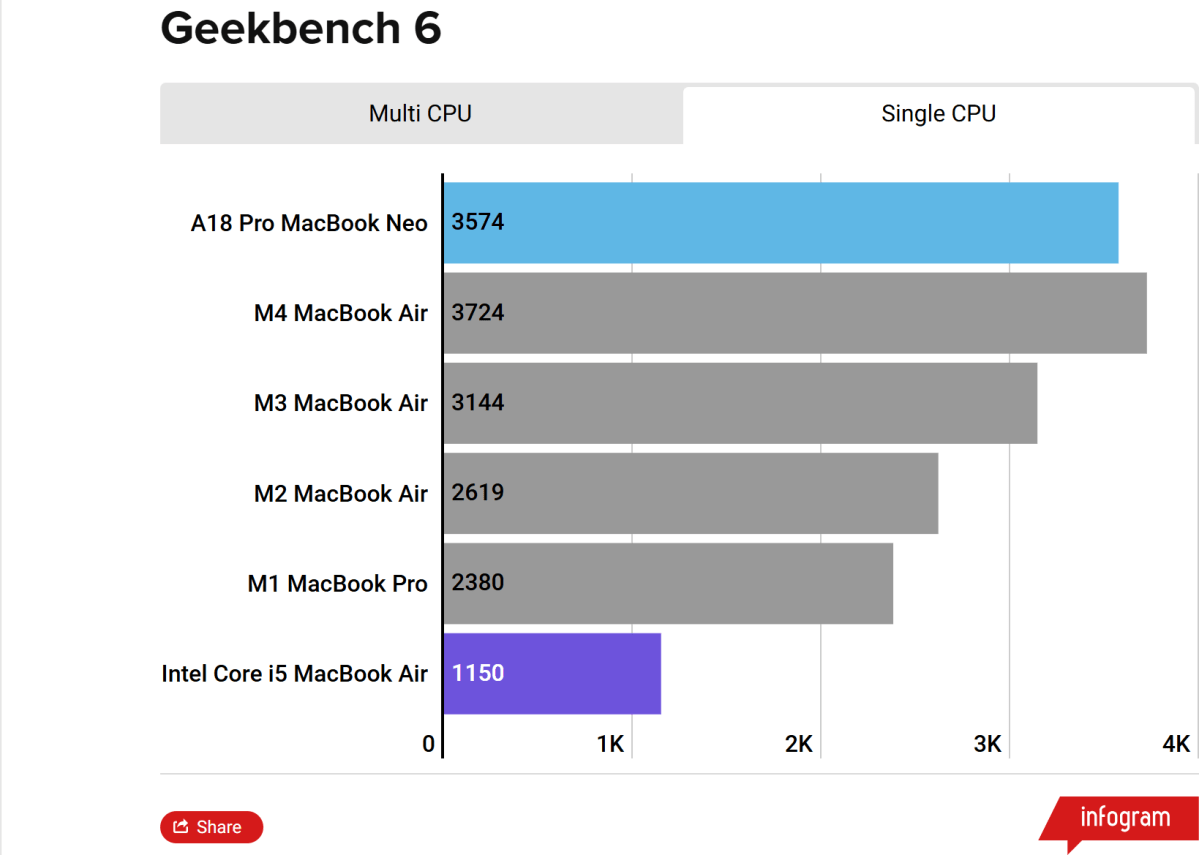
The gap widens when performance is factored in. In Geekbench 6, the MacBook’s Neo A18 Pro produces a score of 3,574, more than three times faster than the 1,125 the N150 produced, according to Macworld’s MacBook Neo review and research by CPU-Monkey.com. Single-threaded CPU scores govern how fast the operating system feels, as well as many applications. And that’s still faster than the single-core Geekbench score of 2,908 the Core Ultra X9 388H (Panther Lake) posted in our Panther Lake review.

Apple’s own design process also benefits them. PC makers have always swung back and forth between two business models: vertical integration and a “just-in-time” model. There’s a reason that Dell became such a powerhouse so quickly. It developed the ability to purchase and assemble components and then ship them out the door as finished PCs almost immediately. That can be a bonus during a time of plentiful, cheap chips. In times of shortages, vertical integration — where you not only assemble the components, but design and manufacture as many as possible — can be extremely handy, as a PC maker can know how many components are available, their price, and when they’ll arrive. Apple probably knows how much each CPU will cost, down to the penny.
That’s what Jim McGregor, an analyst at Tirias Research, attributes to the low price of the MacBook Neo. “Apple controls basically the entire vertical stack, so they have a little bit more flexibility,” he said.
“Because they control the whole product stack, they have more pricing leverage than anybody else in the industry right now,” McGregor added.
Microsoft, on the other hand, simply does what most other PC makers do: It assembles third-party components into a laptop. For a brief time Microsoft codeveloped the SQ3 chip with Qualcomm for the Surface Pro 9 (5G) in 2022, but those days are long over. Microsoft must negotiate with CPU and component vendors like any other PC maker, and since it’s no longer in the top tier of PC makers, it’s probably suffering as much or more than any other.
Doing more with less
By now, you’re well aware that memory prices have more than doubled in price since last year. The MacBook Neo includes just 8GB of RAM. Yes, the “minimum” specifications for Windows 11 are just 4GB, but virtually all Windows laptops use at least 8GB, and most that come across our desk include 16GB total.
Reportedly, the A18 Pro uses low-power DDR5X memory. No one knows what Apple or other PC makers are paying for memory, but the price of 16GB of DDR5 memory has quadrupled from about $100 to over $400 since last October. That hurts Microsoft and other PC makers far more than Apple. (Microsoft has confirmed that it is raising prices because of soaring memory and storage prices.)
Likewise, the MacBook Neo includes 256GB of SSD storage. Here, Apple is probably subject to the same forces as Microsoft, as it’s forced to buy SSDs from third parties. Microsoft’s cheapest 13-inch Surface Laptop also includes 256GB, so there’s no advantage here, either.
“Given the supply issues, Apple’s timing is very good and they’re likely getting some respectable margins relative to the cost of the hardware, which has been an issue for Chromebooks due to the (previously) lower pricing,” McCarron said. “Ultimately the Neo is at a lower price point simply due to the costs being much lower than conventional notebooks including the Surface.”
Hitting the target market
Economists refer to the current economic landscape as a “K”-shaped market: The poor get poorer, with less disposable income; the rich get richer. That means that, over time, more and more manufacturers raise prices to chase the wealthier customers. It’s what some blame for the evolution away from budget cars, for example, or the continued rate increases in Las Vegas hotel rooms.
Tirias analyst McGregor said some of the excuses from the PC market have been essentially a smokescreen.
“The vast majority of the industry is trying to take advantage of this opportunity to raise prices, even though a lot of them are blaming it on memory prices,” McGregor said. “Quite honestly, AMD, Intel, pretty much everybody across the board is taking advantage of it, saying we’re going to raise prices because we know there’s going to be limited capacity, limited units, limited production, so…we’re only going to focus on the high end of the market.”


Mark Hachman/Foundry
As for Microsoft, “they view their competition as being Apple, period, and they want to go after Apple, and Apple’s biggest margins are in its premium segment,” McGregor said.
At one time, Microsoft did have plans to take on the low-end Chromebook market, with devices like the Surface Laptop Go and the Surface Go, and their various iterations like the Surface Laptop Go 3. But those devices quietly vanished around the time that one-time Surface chief Panos Panay left for Amazon. Now, Surface carries the standard for Windows on Arm, which has been driven exclusively by Qualcomm for the last few years. That could change.
Still, McGregor also thinks that the MacBook Neo could end up being a warning shot to potential competitors. Although nothing has been announced, Nvidia’s N1X Arm processor should debut this year, possibly at the Computex show in Taiwan in June.
“So I think it’s also kind of a preemptive strike, if you will, to say we’re going to make sure that if you know of any other compatible or Arm-based solution, we’re still going to beat it,” McGregor said.